


Page 74 - MI-2-2
P. 74
Microbes & Immunity                                                   Biological activity of Amazonian plants


            Amapari municipality) and in the Amapa “cerrado”
            (savanna) at 0°55’51”N/51°11’35”W (Ferreira Gomes
            municipality), respectively (Figure 1). One hundred grams
            of each dried and pulverized plant material, including
            the leaves of LM and the bark of OH, were macerated
            in 1  L of ethanol for 7  days at room temperature. This
            procedure was repeated 3 times. The extract was obtained
            using a rotary evaporator (Quimis, Brasil) at 40°C under
            low pressure and kept under refrigeration until use. Plant
            materials of OH and LM were deposited at the Institute
            of Scientific and Technological Research of Amapa State
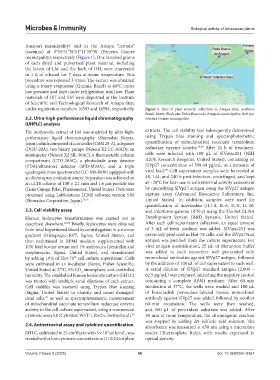
            under registration numbers 16593 and 16594, respectively.  Figure  1. Sites of plant material collection in Amapa state, northern
                                                               Brazil. Notes: Black pin: Pedra Branca do Amapari municipality; Red pin:
            2.2. Ultra-high-performance liquid chromatography   Ferreira Gomes municipality.
            (UHPLC) analysis
            The methanolic extract of LM was analyzed by ultra-high-  extracts. The cell viability was subsequently determined
            performance  liquid chromatography (Shimadzu Nexera,   using Trypan blue staining and spectrophotometric
            Japan), which composed of a controller (CBM 20-A), a degasser   quantification of mitochondrial succinate tetrazolium
            (DGU-20A), two binary pumps (Nexera X2 LC-30AD), an   reductase enzyme activity. 29,30  After 24  h of treatment,
            autoinjector (Nexera X2 SIL-30AC), a thermostable column   cells were infected with 100  µL of SIVmac251 (NIH
            compartment  (CTO-20AC),  a  photodiode  array  detector   AIDS Research Reagents, United States), containing an
            (PDA)/ultraviolet detector (SPD-M20A), and a triple   SIVp27 concentration of 599.64 pg/mL, as a measure of
                                                                       27
            quadrupole mass spectrometer (LC-MS-8030) equipped with   viral load.  Cell supernatant samples were harvested at
            an electrospray ionization source. Separation was achieved on   48, 144, and 240 h post-infection, centrifuged, and kept
            an LC18 column of 100 × 2.1 mm and 1.6 µm particle size   at −20°C for later use in antiretroviral activity assessment
            (Luna Omega Polar, Phenomenex, United States). Data were   by quantifying SIVp27 antigen using the SIVp27 antigen
            processed using LabSolutions LCMS software version  5.96   capture  assay  (Advanced  Bioscience  Laboratory,  Inc,
            (Shimadzu Corporation, Japan). 13,15               United States). In addition, samples were used for
                                                               quantification of interleukin (IL)-4, IL-6, IL-8, IL-10,
            2.3. Cell viability assay                          and interferon-gamma (IFN-γ) using the DuoSet ELISA
            Human leukocytes transformation was  carried  out  as   Development System (R&D Systems, United States).
            described elsewhere. 26,27  Briefly, leukocytes were obtained   After each cell supernatant collection, an equal amount
            from total heparinized blood by centrifugation in a sucrose   of 3  mL of fresh medium was added. SIVmac251 was
            gradient (Histopaque-1077, Sigma, United States), and   previously produced in Hut-78 cells, and the SIVp27viral
            then maintained in RPMI medium supplemented with   antigen was purified from the culture supernatant. For
            10% fetal bovine serum and 1% antibiotics (penicillin and   viral  antigen  quantification,  25  µL  of  disruption  buffer
            streptomycin, Sigma, United States), and transformed   was added to each microtiter well pre-coated with
            by adding 10% of Hut-78  cell culture supernatant. Cells   monoclonal antibodies against SIVp27 antigen, followed
                                28
            were cultivated in an incubator (Sanyo, Fisher Scientific,   by the addition of 100 µL of cell supernatant to each well.
            United States) at 37°C, 5% CO  atmosphere, and controlled   A  serial dilution of SIVp27 standard antigen (2,000 –
                                    2
            humidity. The established human leukocyte culture (EHLC)   62.5 pg/mL) was prepared, including the negative control
            was treated with multiple serial dilutions of each extract.   containing a complete RPMI medium. After 60-min
            Cell viability was assessed using Trypan blue staining   incubation at 37°C, the wells were washed and 100  µL
            (Sigma, United States) to identify and count damaged/  of horseradish peroxidase-labeled mouse monoclonal
            dead cells,  as well as spectrophotometric measurement   antibody against SIVp27 was added, followed by another
                    29
            of mitochondrial succinate tetrazolium reductase enzyme   60-min incubation. The wells were then washed,
            activity in the cell culture supernatant, using a commercial   and 100  µL of peroxidase substrate was added. After
            cytotoxic assay kit (CytoSkan WST-1, Roche, Switzerland). 30  30 min at room temperature, the chromogenic reaction
                                                               was stopped by adding 2N sulfuric acid solution. The
            2.4. Antiretroviral assay and cytokine quantification  absorbance was measured at 450 nm using a microplate
            EHLC, cultivated in 25 cm  flasks with 5 × 10  cells/mL, was   reader (Thermoplate, Italy), with results expressed in
                                 2
                                               5
            treated with a low cytotoxic concentration (1:1024) of plant   optical density.
            Volume 2 Issue 2 (2025)                         66                               doi: 10.36922/mi.8367

