


Page 121 - MI-2-4
P. 121
Microbes & Immunity                                      Isolation and identification of PEDV strain CHN-CQ-2021


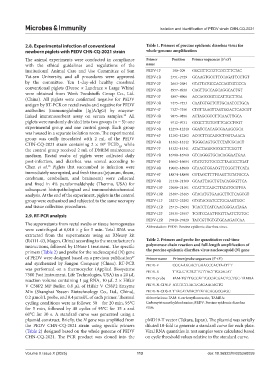
            2.8. Experimental infection of conventional        Table 1. Primers of porcine epidemic diarrhea virus for
            newborn piglets with PEDV CHN-CQ-2021 strain       whole‑genome amplification
            The animal experiments were conducted in compliance   Primer   Position  Primer sequences (5’→3’)
            with the ethical guidelines and regulations of the   name
            Institutional Animal Care and Use Committee of Sun   PEDV-1F  190–209  GGCGTTCCGTCGCCTTCTAC
            Yat-sen University, and all procedures were approved   PEDV-1R  2751–2729  GCAAGTGCCTTCCAGATTCCTGT
            by the committee. Ten 1-day-old healthy crossbred   PEDV-2F   2663–2684  GTATTATGCCACCAGTGTCCCA
            conventional piglets (Duroc × Landrace × Large White)   PEDV-2R  4957–4938  CAGTTGCCAGCAGGCACTGT
            were obtained from Wen’s Foodstuffs Group  Co., Ltd.
            (China). All piglets were confirmed negative for PEDV   PEDV-3F  4887–4906  ACCAGCGGTGCATTGCTTGA
            antigen by RT-PCR on rectal swabs and negative for PEDV   PEDV-3R  7475–7453  CAATGTGCTCTTGCAATCCTGCA
            antibodies (immunoglobulin [Ig]A/IgG) by enzyme-   PEDV-4F    7327–7350  CTGTTAAGTTAGTGGACTCAGCGT
            linked immunosorbent assay on serum samples.  All   PEDV-4R   9875–9856  ACTAGCGCCTTCAACTTGCA
                                                      25
            piglets were randomly divided into two groups (n = 5): one   PEDV-5F  9712–9731  GCGCTTGTGGTTCACCTGGT
            experimental group and one control group. Each group   PEDV-5R  12259–12240 GGATCCACAGCGAAAGCGCA
            was housed in a separate isolation room. The experimental   PEDV-6F  12182–12202 ACGCTTGCAGGCTGGTAAACA
            group  was  orally  inoculated  with  2  mL  of  the  PEDV
            CHN-CQ-2021 strain containing 2 × 10  TCID , while   PEDV-6R  14462–14442 TGGGCAGTGCTCTATCGCACT
                                             6
                                                    50
            the control group received 2 mL of DMEM maintenance   PEDV-7F  14322–14341 ATACTAGGGGCGCTTCGGTT
            medium.  Rectal  swabs  of  piglets  were  collected  daily   PEDV-7R  16780–16760 GTCAGGGTGCACAGGAATGAA
            post-infection, and diarrhea was scored according to   PEDV-8F  16662–16684 GTATGTGTGCCCTTAAGCCTGAT
            Chen  et al.  Piglets that succumbed to infection were   PEDV-8R  19002–18980 GTAAGTGGACGTTCGGCTTCATA
                     26
            immediately necropsied, and fresh tissues (jejunum, ileum,   PEDV-9F  18874–18898 CGTAGCTTTTGAGTTGTATGCCA
            cerebrum, cerebellum, and brainstem) were collected   PEDV-9R  21330–21309 GCAATTAGCTGTACAGGGTTCA
            and fixed in 4% paraformaldehyde (Thermo, USA) for
            subsequent histopathological and immunohistochemical   PEDV-10F  21080–21101 CCATTCCAGCTTATATGCGTGA
            analysis. At the end of the experiment, piglets in the control   PEDV-10R  23487–23465 GTACATGTGAAGCTTCTCAGCGT
            group were euthanized and subjected to the same necropsy   PEDV-11F  23272–23292 GTGTACGATCCTGCAAGTGGC
            and tissue collection procedures.                  PEDV-11R  25715–25694 TCACCTCATCAACGGGAATAGA
            2.9. RT-PCR analysis                               PEDV-12F  25535–25557 TCGTCCAATTGGTTAATCTGTGC
                                                               PEDV-12R  27840–27820 TACCGTTGTGTGCAAGACCAA
            The supernatants from rectal swabs or tissue homogenates   Abbreviation: PEDV: Porcine epidemic diarrhea virus.
            were centrifuged at 6,010 × g for 5 min. Total RNA was
            extracted from the supernatants using an RNeasy kit
            (R4111-03, Magen, China) according to the manufacturer’s   Table 2. Primers and probe for quantitative real‑time
            instructions, followed by DNase I treatment. The specific   polymerase chain reaction and full‑length amplification of
            primers (Table 2) and probe for the nucleocapsid (N) gene   the porcine epidemic diarrhea virus nucleocapsid (N) gene
            of PEDV were designed based on a previous publication    Primer name  Primer/probe sequences (5’→3’)
                                                         27
            and synthesized by Sangon Company (China). RT-PCR   PEDV-F    CGCAAAGACTGAACCCACTAATTT
            was performed on a thermocycler (Applied Biosystems   PEDV-R  TTGCCTCTGTTGTTACTTGGAGAT
            7500 Fast instrument, Life Technologies, USA) in a 20 μL
            reaction volume containing 1 μg RNA, 10 μL 2 × Hifair   PEDV-probe  FAM-TGTTGCCATTGCCACGACTCCTGC-TAMRA
            V C58P2 MP Buffer, 0.8 μL of Hifair V C58P2 Enzyme   PEDV-N-CDS-F ATGTCTGACGCAGAAGAGTG
            Mix  (Shanghai  Yeasen  Biotechnology Co.,  Ltd.,  China),   PEDV-N-CDS-R TTACATATACTTATACAGGCGAGC
            0.2 μmol/L probe, and 0.4 μmol/L of each primer. Thermal   Abbreviations: FAM: 6-carboxyfluorescein; TAMRA:
            cycling conditions were as follows: 50℃ for 20 min, 95°C   Carboxytetramethylrhodamine; PEDV: Porcine epidemic diarrhea
            for 5  min, followed by 40  cycles of 95°C for 15 s and   virus.
            60°C for 30 s. A  standard curve was generated using a
            plasmid construct. Briefly, the N gene was amplified from   pMD19-T vector (Takara, Japan). The plasmid was serially
            the PEDV CHN-CQ-2021 strain using specific primers   diluted 10-fold to generate a standard curve for each plate.
            (Table 2) designed based on the whole genome of PEDV   Viral RNA quantities in test samples were calculated based
            CHN-CQ-2021. The PCR product was cloned into the   on cycle threshold values relative to the standard curve.


            Volume X Issue X (2025)                        113                           doi: 10.36922/MI025260059

