


Page 126 - MI-2-4
P. 126
Microbes & Immunity                                      Isolation and identification of PEDV strain CHN-CQ-2021


                                    A                   B


                                    C                   D                   E


                                    F                   G                   H


                                    I                   J                   K


                                    L                   M                   N


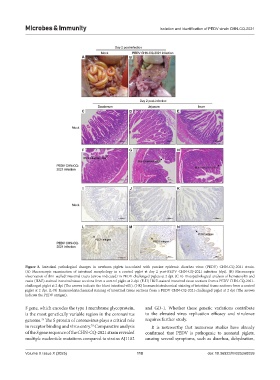
            Figure  8. Intestinal pathological changes in newborn piglets inoculated with porcine epidemic diarrhea virus (PEDV) CHN-CQ-2021 strain.
            (A)  Macroscopic  examination of intestinal morphology in a control piglet at day 2 post-PEDV CHN-CQ-2021 infection (dpi). (B) Macroscopic
            observation of thin-walled intestinal tracts (arrow-indicated) in PEDV-challenged piglets at 2 dpi. (C-E) Histopathological analysis of hematoxylin and
            eosin (H&E)-stained intestinal tissue sections from a control piglet at 2 dpi. (F-H) H&E-stained intestinal tissue sections from a PEDV CHN-CQ-2021-
            challenged piglet at 2 dpi (The arrows indicate the blunt intestinal villi). (I-K) Immunohistochemical staining of intestinal tissue sections from a control
            piglet at 2 dpi. (L-N) Immunohistochemical staining of intestinal tissue sections from a PEDV CHN-CQ-2021-challenged piglet at 2 dpi (The arrows
            indicate the PEDV antigen).

            S gene, which encodes the type I membrane glycoprotein,   and GD-1. Whether these genetic variations contribute
            is the most genetically variable region in the coronavirus   to  the  elevated  virus  replication  efficacy  and  virulence
            genome.  The S protein of coronavirus plays a critical role   requires further study.
                   33
            in receptor binding and virus entry.  Comparative analysis   It is noteworthy that numerous studies have already
                                        33
            of the S gene sequence of the CHN-CQ-2021 strain revealed   confirmed that PEDV is pathogenic to neonatal piglets,
            multiple nucleotide mutations compared to strains AJ1102   causing several symptoms, such as diarrhea, dehydration,


            Volume X Issue X (2025)                        118                           doi: 10.36922/MI025260059

