


Page 122 - MI-2-4
P. 122
Microbes & Immunity                                      Isolation and identification of PEDV strain CHN-CQ-2021


            2.10. Histological and immunohistochemical
            analysis
            Tissue samples collected from piglets were subjected to   A                 B
            histopathological and  immunohistochemical analyses  as
            previously described, with some modifications.  Briefly,
                                                   22
            samples were fixed in 4% paraformaldehyde for over 36 h,
            dehydrated through a graded ethanol series, embedded
            in paraffin, sectioned, and mounted on glass slides. For
            histopathological examination, sections (5  μm) were
            dewaxed, rehydrated, and stained with hematoxylin and
            eosin for observation under a conventional light microscope.   C
            For immunohistochemical analysis, sections were blocked                     D
            with 1% BSA and incubated with a diluted PEDV-specific
            mouse antiserum (1:100; M100048, Zoonogen, China) at
            4℃ for 12 h. After washing, the sections were incubated
            in a diluted peroxidase-labeled goat anti-mouse IgG
            secondary antibody (1:200; SA00001-1, Proteintech, USA)
            at room temperature for 50 min. Finally, the sections were
            treated with 3,3’-diaminobenzidine chromogen kit (K3468,
            Dako, Denmark) and counterstained with hematoxylin.
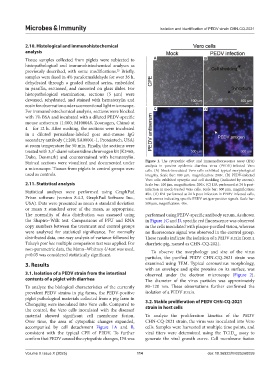
            Stained sections were visualized and documented under   Figure  1. The cytopathic effect and immunofluorescence assay (IFA)
            a microscope. Tissues from piglets in control groups were   analysis  in  porcine  epidemic  diarrhea  virus  (PEDV)-infected  Vero
                                                               cells.  (A) Mock-inoculated Vero cells exhibited typical morphological
            used as controls.                                  integrity. Scale bar: 100  μm, magnification: 200×. (B) PEDV-infected
                                                               Vero cells exhibited syncytia and cell shedding (indicated by arrows).
            2.11. Statistical analysis                         Scale bar: 100 μm, magnification: 200×. (C) IFA performed at 24 h post-
            Statistical analyses were performed using  GraphPad   infection in mock-treated Vero cells. Scale bar: 500 μm, magnification:
                                                               40×. (D) IFA performed at 24 h post-infection in PEDV-infected cells,
            Prism software (version  8.4.3,  GraphPad Software Inc.,   with arrows indicating specific PEDV antigen-positive signals. Scale bar:
            USA). Data were presented as mean ± standard deviation   500 μm, magnification: 40×.
            or mean ± standard error of the  mean, as  appropriate.
            The normality of data distribution was assessed using   performed using PEDV-specific antibody serum. As shown
            the Shapiro–Wilk test. Comparisons of PFU and RNA   in Figure 1C and D, specific red fluorescence was observed
            copy numbers between the treatment and control groups   in the cells inoculated with plaque-purified virion, whereas
            were analyzed for statistical significance. For normally   no fluorescence signal was observed in the control group.
            distributed data, one-way analysis of variance followed by   These results indicate the isolation of a PEDV strain from a
            Tukey’s post hoc multiple comparison test was applied. For   diarrheic pig, named as CHN-CQ-2021.
            non-parametric data, the Mann–Whitney U-test was used.   To observe the morphology and size of the virus
            p<0.05 was considered statistically significant.
                                                               particles, the purified PEDV CHN-CQ-2021 strain was
            3. Results                                         examined using TEM. Typical coronavirus morphology,
                                                               with an envelope and spike proteins on its surface, was
            3.1. Isolation of a PEDV strain from the intestinal   observed under  the electron microscope  (Figure  2).
            contents of a piglet with diarrhea                 The diameter of the virus particles was approximately
            To analyze the biological characteristics of the currently   80–120  nm. These observations further confirmed the
            prevalent PEDV strains in pig farms, the PEDV-positive   isolation of a PEDV strain.
            piglet pathological materials collected from a pig farm in   3.2. Stable proliferation of PEDV CHN-CQ-2021
            Chongqing were inoculated into Vero cells. Compared to
            the control, the Vero cells inoculated with the diseased   strain in host cells
            material showed significant cell membrane fusion.   To analyze the proliferation kinetics of the PEDV
            Over time, the area of cytopathic changes expanded,   CHN-CQ-2021 strain, the virus was inoculated into Vero
            accompanied by cell detachment  Figure  1A and  B,   cells. Samples were harvested at multiple time points, and
            consistent  with  the  typical CPE  of  PEDV.  To  further   viral titers were determined using the TCID  assay to
                                                                                                     50
            confirm that PEDV caused the cytopathic changes, IFA was   generate the viral growth curve. Cell membrane fusion

            Volume X Issue X (2025)                        114                           doi: 10.36922/MI025260059

