


Page 124 - MI-2-4
P. 124
Microbes & Immunity                                      Isolation and identification of PEDV strain CHN-CQ-2021


                         A                              B


            Figure  4. Phylogenetic trees of the whole genome  and  S gene of porcine epidemic diarrhea virus (PEDV) CHN-CQ-2021.  (A) The genome-wide
            phylogenetic  tree constructed using the neighbor-joining method in the MEGA software package (version  5, http://www.megasoftware.net/). (B)
            Phylogenetic tree of S genes of PEDV constructed using the neighbor-joining method in the MEGA software package (version 5, http://www.megasoftware.
            net/). Reference sequences, obtained from the GenBank database, are annotated with their respective strain names. The evolutionary distance scale bar
            corresponds to 0.005 nucleotide substitutions per site.


                         A                    B                       C


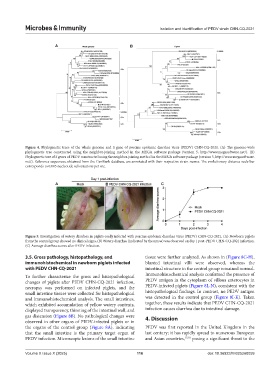
            Figure 5. Investigation of watery diarrhea in piglets orally infected with porcine epidemic diarrhea virus (PEDV) CHN-CQ-2021. (A) Newborn piglets
            from the control group showed no clinical signs. (B) Watery diarrhea (indicated by the arrow) was observed on day 1 post-PEDV CHN-CQ-2021 infection.
            (C) Average diarrhea scores after PEDV infection.

            3.5. Gross pathology, histopathology, and          tissue were further analyzed. As shown in (Figure 8C-H),
            immunohistochemical in newborn piglets infected    blunted intestinal villi were observed, whereas the
            with PEDV CHN-CQ-2021                              intestinal structure in the control group remained normal.

            To further characterize the gross and histopathological   Immunohistochemical analysis confirmed the presence of
            changes of piglets after PEDV CHN-CQ-2021 infection,   PEDV antigen in the cytoplasm of villous enterocytes in
            necropsy was performed on infected piglets, and the   PEDV-infected piglets (Figure 8L-N), consistent with the
            small intestine tissues were collected for histopathological   histopathological findings. In contrast, no PEDV antigen
            and immunohistochemical analysis. The small intestines,   was detected in the control group (Figure  8I-K). Taken
            which exhibited accumulation of yellow watery contents,   together, these results indicate that PEDV CHN-CQ-2021
            displayed transparency, thinning of the intestinal wall, and   infection causes diarrhea due to intestinal damage.
            gas distension (Figure 8B). No pathological changes were   4. Discussion
            observed in other organs of PEDV-infected piglets or in
            the organs of the control group (Figure  8A), indicating   PEDV was first reported in the United  Kingdom in the
            that the small intestine is the primary target organ of   last century; it has rapidly spread to numerous European
            PEDV infection. Microscopic lesions of the small intestine   and Asian countries, 17,18  posing a significant threat to the


            Volume X Issue X (2025)                        116                           doi: 10.36922/MI025260059

