


Page 77 - MI-2-4
P. 77
Microbes & Immunity                                             Dietary emulsifiers affect the presence of AIEC


            (Supplementary File). The food additives questionnaire was   of variance (PERMANOVA) test. Differentially abundant
            validated in a CD survey across Australia, Hong Kong, and   taxa and functional modules were identified using a linear
            mainland China to identify the exposure to food additives   mixed model with the geographic region as a random
            in  CD  patients  and  healthy  controls. 11,20   Our  study  also   effect. The batch effect of microbiome data was adjusted
                                                                                      22
            incorporated a secondary dataset of CD patients and healthy   by the MMUPHin method.  A sensitivity analysis was
            controls from Hong Kong as an urban cohort.  The subjects   performed  to verify the  robustness  of differentially
                                                8
            in the urban cohort were recruited from the Prince of Wales   abundant taxa using the adjusted microbiome data. After
            Hospital in Hong Kong (population density = 6582.6/km ).    selecting the significantly different genera, we validated the
                                                       2 21
            All participants had not been exposed to antibiotics,   discrimination ability of selected microbial genera using
            probiotics,  or  prebiotics in the past three  months before   the random forest model. Five-fold cross-validation was
            enrollment. All participants gave informed consent, and the   applied during the model training. The model was trained
            study was conducted in accordance with the Declaration of   in 80% of CD patients from two cohorts and validated
            Helsinki. The identification of AIEC presence, sample DNA   on the remaining 20% of CD patients and those patients
            extraction, and 16S amplicon sequencing were detailed   from different regions. We also compared the functional
            in  the  Supplementary  Methods  section.  The  study  was   differences in CD patients with and without AIEC presence
            approved by the Research Ethics Committee of the First   using a linear mixed model.
            Affiliated Hospital of Kunming Medical School (reference
            no. 2017.L.15-1).                                  3. Results
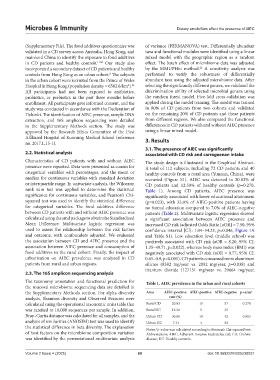
                                                               3.1. The presence of AIEC was significantly
            2.2. Statistical analysis                          associated with CD risk and carrageenan intake
            Characteristics  of  CD  patients  with  and  without  AIEC   The study design is illustrated in the Graphical Abstract.
            presence were reported. Data were presented as counts for   A total of 112 subjects, including 72 CD patients and 40
            categorical variables with percentages, and the mean or   healthy controls from a rural area (Yunnan, China), were
            median for continuous variables with standard deviation   recruited (Figure S1). AIEC was detected in 20.83% of
            or interquartile range. In univariate analysis, the Wilcoxon   CD  patients  and  12.50%  of  healthy  controls  (p=0.270,
            rank sum test was applied to determine the statistical   Table  1). Among CD patients, AIEC presence was
            significance for continuous variables, and Pearson’s Chi-  significantly associated with lower educational attainment
            squared test was used to identify the statistical difference   (p=0.023), with 33.0% of AIEC-positive patients having
            for categorical variables. The food additives difference   no formal education compared to 7.0% of AIEC-negative
            between CD patients with and without AIEC presence was   patients (Table 2). Multivariate logistic regression showed
            calculated using the smd package to obtain the Standardized   a significant association between AIEC presence and
            Mean  Difference.  Multivariate  logistic  regression  was   increased CD risk (adjusted Odds Ratio [aOR] = 7.50, 95%
            used  to  assess the relationship  between  the  risk  factors   confidence interval [CI]: 1.04–54.23, p=0.046, Figure 1A
            and outcome, with confounders adjusted. We evaluated   and Table S1). Low education level (middle school) was
            the association between CD and AIEC presence and the   positively associated with CD risk (aOR = 8.20, 95% CI:
            association between AIEC presence and consumption of   1.35–49.71, p=0.022), whereas body mass index (BMI) was
            food additives in the rural cohort. Finally, the impact of   negatively associated with CD risk (aOR = 0.77, 95% CI:
            urbanization on AIEC prevalence was analyzed in CD   0.65–0.9, p=0.001). CD patients consumed more aluminum
            patients from rural and urban regions.             silicate  (8382  mg/year  vs.  2092  mg/year,  p=0.038)  and
                                                               titanium dioxide (127151  mg/year vs. 29664  mg/year,
            2.3. The 16S amplicon sequencing analysis
            The taxonomy annotation and functional prediction for   Table 1. AIEC prevalence in the urban and rural cohorts
            the mucosal microbiome sequencing data are detailed in
            the  Supplementary Methods section.  For  alpha  diversity   Area  AIEC‑positive  AIEC‑positive AIEC‑negative p‑value †
            analysis, Shannon diversity and Observed Features were       rate (%)
            calculated using the operational taxonomic units table that   Rural CD  20.83  15   57      0.270
            was rarefied to 10,000 sequences per sample. In addition,   Rural HC  12.50  5      35
            Bray–Curtis distance was calculated for all samples, and the   Urban CD  30.00  18  42      0.003
            analysis of similarities (ANOSIM) test was used to identify   Urban HC  7.14  4     52
            the statistical difference in beta diversity. The explanation   Notes: p-value was calculated according to Pearson’s Chi-squared test.
                                                                    †
            of host factors on the microbiome composition variation   Abbreviations: AIEC: Adherent-invasive Escherichia coli; CD: Crohn’s
            was identified by the permutational multivariate analysis   disease; HC: Healthy controls.


            Volume 2 Issue 4 (2025)                         69                           doi: 10.36922/MI025230051

