


Page 79 - MI-2-4
P. 79
Microbes & Immunity                                             Dietary emulsifiers affect the presence of AIEC


                         A


                         B


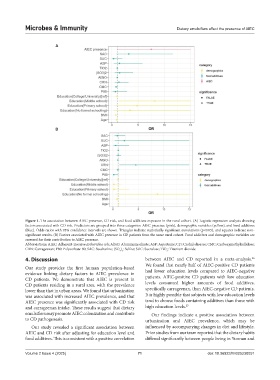
            Figure 1. The association between AIEC presence, CD risk, and food additives exposure in the rural cohort. (A) Logistic regression analysis showing
            factors associated with CD risk. Predictors are grouped into three categories: AIEC presence (pink), demographic variables (yellow), and food additives
            (blue). Odds ratios with 95% confidence intervals are shown. Triangles indicate statistically significant associations (p<0.05), and squares indicate non-
            significant results. (B) Factors associated with AIEC presence in CD patients from the same rural cohort. Food additives and demographic variables are
            assessed for their contribution to AIEC presence.
            Abbreviations: AIEC: Adherent-invasive Escherichia coli; AlSiO: Aluminum silicate; ASP: Aspartame; CD: Crohn’s disease; CMC: Carboxymethylcellulose;
            CRN: Carrageenan; P80: Polysorbate-80; SAC: Saccharine; (SO ) : Sulfite; SUC: Sucralose; TiO : Titanium dioxide.
                                                                        2
                                                    3 2
            4. Discussion                                      between AIEC and CD reported in a meta-analysis.
                                                                                                            26
                                                               We found that nearly half of AIEC-positive CD patients
            Our study provides the first human population-based   had lower education levels compared to AIEC-negative
            evidence linking dietary factors to AIEC prevalence in
            CD patients. We demonstrate that AIEC is present in   patients. AIEC-positive CD patients with low education
            CD patients residing in a rural area, with the prevalence   levels consumed higher amounts of food additives,
            lower than that in urban areas. We found that urbanization   specifically carrageenan, than AIEC-negative CD patients.
            was associated with increased AIEC prevalence, and that   It is highly possible that subjects with low education levels
            AIEC presence was significantly associated with CD risk   tend to choose foods containing additives than those with
            and carrageenan intake. These results suggest that dietary   high education levels. 27
            emulsifiers may promote AIEC colonization and contribute   Our findings indicate a positive association between
            to CD pathogenesis.                                urbanization and AIEC prevalence, which may be
              Our study revealed a significant association between   influenced by accompanying changes in diet and lifestyle.
            AIEC and CD risk after adjusting for education level and   Prior studies from our team reported that the dietary habits
            food additives. This is consistent with a positive correlation   differed significantly between people living in Yunnan and


            Volume 2 Issue 4 (2025)                         71                           doi: 10.36922/MI025230051

