


Page 78 - MSAM-1-1
P. 78
Materials Science in Additive Manufacturing A ML model for AM PSP of Ti64
Where, the function p(m,x) represents the probability were computed in both orthogonal orientations (x and y)
density of finding the local state m at the spatial location then concatenated with 2-point correlation function data
x. In this function, m and x can be treated as either to build up a large feature vector for each microstructure
continuous variables or discretized descriptors. In this SVE (i.e., each SEM image). In summary, the PCA input
study, the Ti-6Al-4V phase information is considered the deduces microstructure information collected from SEM
local state space. Therefore, the function f(m,m’|r) denotes characterization.
the conditional probability of finding different phases
(α/β) in spatial bins across a Ti-6Al-4V microstructure, 2.2.2. XRD data extraction
which are separated by the vector set r. In addition to the influence of microstructures collected
According to Liu and Shin (2019), it is important to from the SEM microstructure, Hansen (1958) indicated
include multiple descriptors to capture all the elements that other characterization features, such as residual stress,
of heterogeneous grain morphology for developing also have direct effects on mechanical properties and
[32]
a robust microstructure data science PSP linkage . machining behavior . AM fabrication inherently leads to
[9]
Therefore, besides the correlation functions, chord length a rapid cooling rate and therefore large thermal gradients
that cause phase transformations, and generates significant
distributions (CLDs) which are direct descriptors of the residual stresses. Telrandhe et al. (2017) have shown that
grain morphology are also applied to the workflow. The near-surface residual stresses have a significant impact on
rationale behind this approach is to capture additional mechanical behavior, such as fatigue and microhardness .
[33]
microstructure features of interest in metal AM parts: Grain During the post-processing of metal AM parts, machining
size, shape distribution, and their anisotropy. In addition, is often required to achieve desired geometric dimensioning
Turner et al. (2016) have shown that the chord length and tolerancing (GD&T), as well as desired surface finish.
directly connects to the material’s plastic properties, which Therefore, the near-surface residual stresses play a key role
could be a valid statistical method for this workflow . in the post-processing machining behavior of AM surfaces.
[30]
The computational cost of CLDs is relatively low and is, XRD is one of the most widely used non-destructive
therefore, ideal for this study that aims to analyze a large near-surface residual stress measurement methods. XRD
ensemble of microstructures. directly measures the strain due to the distortion of the
In this study, a chord is defined as a line segment crystalline lattice structure from residual stress.
that begins and ends at the boundaries of a single grain In this study, the near-surface residual stress was
contained within the microstructure. CLDs describe the considered an independent input to the S-P linkage model.
probability of locating a chord of a specific length within Specimens representing each PFB process, heat treatment
microstructure SVEs. In this study, CLDs were computed condition, and vertical and horizontal surfaces to build
in X and Y direction as all microstructure images were direction were used to measure residual stress in the
collected in the same X and Y plane orientation from axial direction. All measurements were made using the
surfaces that share the same X and Y coordinates. sin ψ technique in an X-ray diffractometer with a Cu K-α
2
The next step of the microstructure data extraction source (1.5406 Å). Strain and residual stresses were calculated
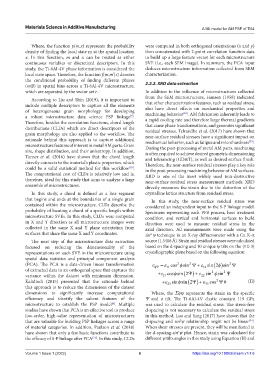
focused on reducing the dimensionality of the based on the d-spacing and 10 unique tilts on the {1 0 3}
representations on each SVE in the microstructure using crystallographic plane based on the following equation:
spatial data statistics and principal component analysis
(PCA). The PCA is a data-driven linear transformation cos 2 sin 2 sin 2 sin 2
of extracted data to an orthogonal space that captures the 11 12 2 2
variance within the dataset with minimum dimension. 13 cossin 2 sin siin
22
Kalidindi (2015) presented that the rationale behind 23 sinsin 2 33 cos # (II)
2
this approach is to reduce the dimensions of the dataset
dimensions to significantly increase computational Where, the åφψ represents the strain in the specific
efficiency and identify the salient features of the and ø tilt. The Ti-6Al-4V elastic constant 119 GPa
microstructure to establish the PSP model . Multiple was used to calculate the residual stress. The stress-free
[4]
studies have shown that PCA is an effective tool to produce d-spacing is not necessary to calculate the residual stress
low-order, high-value representation of microstructures in this method. Luo and Yang (2017) have shown that the
that are valuable for building PSP linkages across a range d-spacing and sin ψ relationship might not be linear .
2
[34]
of material categories. In addition, Paulson et al. (2018) When shear stresses are present, they will be manifested in
have shown that only a few basic functions contribute to the d-spacing-sin ψ plot. Hence, strain was calculated for
2
the efficacy of S-P linkage after PCA . In this study, CLDs different ψ tilts angles in this study using Equation (II) and
[31]
Volume 1 Issue 1 (2022) 6 https://doi.org/10.18063/msam.v1i1.6

