


Page 83 - MSAM-1-1
P. 83
Materials Science in Additive Manufacturing                                A ML model for AM PSP of Ti64


            Figure 5 shows the individual variance for each PC. It is   Figure  6  shows  an example  of  EBSD observation  on
            evident that cumulative variance increases with increasing   the heat-treated L-PBF XY plane sample and Table S1 in
            numbers of PCs. The PCA cumulative variance approaches   the Supplementary File shows the average SF at different
            to >99% as the number of PCs increases to 238.     slip systems and Taylor factor of different strain rates for
              Therefore, the total dimension of microstructural   different AM material surfaces.
            representation was reduced to 238, which reduces the   3.2. ML model and cross-validation results
            dimension of the descriptor matrix by more than 92% when
            compared with the original input matrix. This was critical to   The goal of this study to establish the S-P linkage by training
            develop an SP linkage model that was both computationally   a regression ML model relies on machining parameters,
            feasible and accurate to predict material response.  microstructure functions, residual stress, and SF input to
                                                               predict the specific cutting energy.
              In this study, XRD residual stresses were measured along
            the direction of machining feed. The X-ray penetration   To construct a  robust  ML model, the first  step is
            depth varied between 25~50 µm, which depends on the    data  preparation.  In  this  study,  the  dataset  contains
            tilt angles. Using XRD crystal strain measurements and   14,400  sample points with 72 different machining
            Equation (II), the average surface residual stresses for all   parameter combinations and 200 sets of microstructure
            six AM material surfaces are presented in Table 2.  data for every AM material surface. After PCA of the SEM
                                                               microstructure, this was reduced to one response variable
              The positive value in residual stress indicates tensile stress,   (specific cutting power) and 262 features: 238 features
            while the negative value indicates compression stress. The   for PCA processed features to represent microstructure
            residual stress on L-PBF surfaces after heat treatment shows   function, three features for the residual stress, nine features
            a decrease in shear stress. However, heat treatment does not   for SFs input, nine features for the Taylor factors input, and
            heavily influence the near-surface crystal principal stress in   three features for the machining parameter combinations
            Y and Z directions in L-PBF specimens. EB-PBF samples   (feed, speed, and depth of cut). For each machining
            as-AM top surface shows the largest compressive stress in   parameter combination, three replicates were conducted,
            the Y-axis direction and the smallest principal stress in the   and the average specific cutting energy was treated as the
            Z-direction, which indicates tensile stress and large shear   response variables.
            stress along with the build orientation in EB-PBF sample.
                                                                 The next step is to train a regression model (random
              Based on the EBSD measurements, the SF and Taylor
            factor (M values) were calculated from crystal orientation   80%  dataset)  for  testing  (20%  dataset).  This  study
                                                               employed XGBoost (eXtreme Gradient Boosting Tree-
            distribution using MATLAB program. Average SF and M   based approach) and linear regression models for training.
            values for each SVE were added to the PCA descriptor   Chen and Guestrin (2016) presented the XGBoost
            matrix. Zhang et al. (2019) indicated that the SF analysis   model, which has been widely used due to its accuracy
            shows SVE with high variants of active twinning and               [28]
            detwinning should have high values of SF . Considering   and interpretability . XGBoost is a regularized gradient
                                             [19]
            the major slip systems in α-Ti-6Al-4V, basal, prismatic,   boosting machine which controls for overfitting by
            and the first-order pyramidal slip systems were applied   employing  a  more regularized  objective  function that
            in the Schmid model, while the critical resolved shear   incorporates both a convex loss function and a penalty
            stress (CRSS) ratio for these selected three slip systems is   parameter for regression tree function. The classical linear
            1:0.7:3. Demir (2009) showed that the deformation strain   regression model is used as the baseline model. Both models
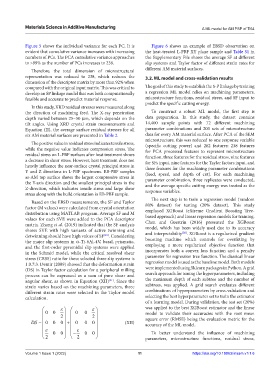
            (DS) in Taylor factor calculation for a peripheral milling   were implemented using Sklearn packages in Python. A grid
            process can be expressed as a sum of pure shear and   search approach for tuning the hyperparameters, including
            angular shear, as shown in Equation (XII) . Since the   the maximum depth of each subtree and the number of
                                               [41]
            strain varies based on the machining parameters, three   subtrees, was applied. A  grid search evaluates different
            different strain rates were selected in the Taylor model   combinations of hyperparameters by cross-validation and
            calculation.                                       selecting the best hyperparameter set to train the estimator
                                                               of a learning model. During validation, the test set (20%)
                                                         was applied to the best XGBoost estimator and the linear
                     0  0     0   0                        model to validate their accuracies with the root mean
                          2          2                     square error (RMSE) being the evaluation metric for the
              DS   0  0  0     0  0  0          (XII)    accuracy of the ML model.

                       0  0      0  0                       To better understand the influence of machining
                    2        2                             parameters, microstructure functions, residual stress,


            Volume 1 Issue 1 (2022)                         11                     https://doi.org/10.18063/msam.v1i1.6

