


Page 84 - MSAM-1-1
P. 84
Materials Science in Additive Manufacturing                                A ML model for AM PSP of Ti64


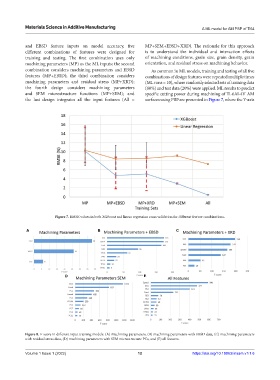
            and EBSD feature inputs on model accuracy, five    MP+SEM+EBSD+XRD). The rationale for this approach
            different combinations of features were designed for   is to understand the individual and interaction effects
            training and testing. The first combination uses only   of machining conditions, grain size, grain density, grain
            machining parameters (MP) as the ML inputs; the second   orientation, and residual stress on machining behavior.
            combination considers machining parameters and EBSD   As common in ML models, training and testing of all five
            features (MP+EBSD); the third combination considers   combinations of design features were repeated multiple times
            machining parameters and residual stress (MP+XRD);   (ML runs = 10), where randomly selected sets of training data
            the fourth design considers machining parameters   (80%) and test data (20%) were applied. ML results to predict
            and SEM microstructure functions (MP+SEM); and     specific cutting power during machining of Ti-6Al-4V AM
            the  last  design  integrates  all  the  input  features  (All  =   surfaces using PBF are presented in Figure 7, where the Y-axis


                        Figure 7. RMSE values in both XGBoost and linear regression cross validation for different feature combinations.

            A                              B                                C


                             D                                E


            Figure 8. F-score in different input training models: (A) Machining parameters, (B) machining parameters with EBSD data, (C) machining parameters
            with residual stress data, (D) machining parameters with SEM microstructure PCs, and (E) all features.


            Volume 1 Issue 1 (2022)                         12                     https://doi.org/10.18063/msam.v1i1.6

