


Page 17 - MSAM-2-2
P. 17
Materials Science in Additive Manufacturing                        Union of 2D nanomaterials and 3D printing


                          A                                      B          C          D


                                                                 E


                         F
                                      H                       I
                                                                                  J

                         G
                                                                                 K


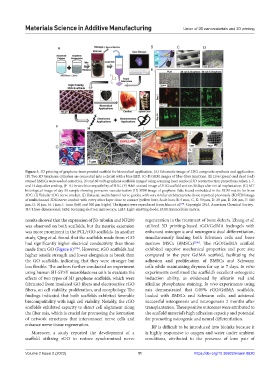
            Figure 5. 3D printing of graphene-incorporated scaffold for biomedical application. (A) Schematic image of 3DG composite synthesis and application.
            (B) Two 3D Graphene cylinders are connected into a circuit with a blue LED. (C–D) SEM images of fiber-fiber junctions. (E) Live (green) and dead (red)
            stained hMSCs were seeded onto PLG, 20 and 60 vol% graphene scaffolds imaged using scanning laser confocal 3D reconstruction projections, taken 1, 7,
            and 14 days after seeding. (F–K) In vivo biocompatibility of 3DG. (F) H&E-stained image of 3DG scaffold section 30 days after initial implantation. (G) MT
            histological image of day 30 sample showing pervasive vascularization (H) SEM image of graphene flake found embedded in the ECM matrix far from
            3DG. (I) Tubular 3DG nerve conduit. (J) Uniaxial, multichannel nerve guides, with very similar architectures to those reported previously. (K) SEM image
            of multichannel 3DG nerve conduit with every other layer close to contact (yellow box). Scale bars: B: 5 mm, C, K: 50 μm, D: 20 μm, E: 200 μm, F: 100
            μm, G: 10 μm, H: 1 μm, J: 1mm (left) and 500 μm (right). The figures were reproduced from Jakus et al. . Copyright 2015, American Chemical Society.
                                                                              [94]
            3D: Three-dimensional; SEM: Scanning electron microscopy; LED: Light-emitting diode; ECM: Extracellular matrix.
            results showed that the expression of β3-tubulin and NF200   regeneration in the treatment of bone defects. Zhang et al.
            was observed on both scaffolds, but the neurite extension   utilized 3D printing-based rGO/GelMA hydrogels with
            was more prominent in the PCL/rGO scaffolds. In another   enhanced osteogenic and neurogenic dual differentiation,
            study, Qing et al. found that the scaffolds made from rGO   simultaneously loading both Schwann cells and bone
            had significantly higher electrical conductivity than those   marrow MSCs (BMSCs) [106] . The rGO/GelMA scaffold
            made from GO (Figure 6) [105] . However, rGO scaffolds had   exhibited superior mechanical properties and pore size
            higher tensile strength and lower elongation at break than   compared to the pure  GelMA scaffold, facilitating the
            the  GO scaffolds,  indicating  that they  were stronger  but   adhesion and proliferation of BMSCs and Schwann
            less flexible. The authors further conducted an experiment   cells while maintaining dryness for up to 7 days. In vitro
            using human SH-SY5Y neuroblastoma cells to evaluate the   experiments confirmed the scaffold’s excellent osteogenic
            effects of two types of 3D graphene scaffolds, which were   induction ability, as evidenced by alizarin red and
            fabricated from insulated GO fibers and electroactive rGO   alkaline phosphatase staining. In vivo experiments using
            fibers, on cell viability, proliferation, and morphology. The   rats demonstrated that 0.05% rGO/GelMA scaffolds,
            findings indicated that both scaffolds exhibited favorable   loaded with BMSCs and Schwann cells, and achieved
            biocompatibility with high cell viability. Notably, the rGO   successful osteogenesis and neurogenesis 2 months after
            scaffolds exhibited capacity to direct cell alignment along   transplantation. These positive outcomes were attributed to
            the fiber axis, which is crucial for promoting the formation   the scaffold material’s high adhesion capacity and potential
            of network structures that interconnect nerve cells and   for promoting osteogenic and neural differentiation.
            enhance nerve tissue regeneration.                   BP is difficult to be introduced into bioinks because it

              Moreover, a study reported the development of a   is highly responsive to oxygen and water under ambient
            scaffold utilizing rGO to restore synchronized nerve   conditions, attributed to the presence of lone pair of


            Volume 2 Issue 2 (2023)                         11                      https://doi.org/10.36922/msam.0620

