


Page 30 - MSAM-2-2
P. 30
Materials Science in Additive Manufacturing                         Water repellence via pinecone structures


                         A                       B                       C


                                    D                        E


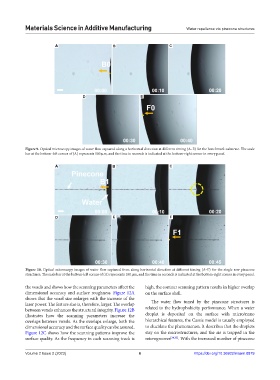
            Figure 9. Optical microscopy images of water flow captured along a horizontal direction at different timing (A–E) for the benchmark substrate. The scale
            bar at the bottom-left corner of (A) represents 100 μm, and the time in seconds is indicated at the bottom-right corner in every panel.

                         A                       B                       C


                         D                       E                       F


             Figure 10. Optical microscopy images of water flow captured from along horizontal direction at different timing (A–F) for the single row pinecone
            structures. The scale bar at the bottom-left corner of (A) represents 100 μm, and the time in seconds is indicated at the bottom-right corner in every panel.

            the voxels and shows how the scanning parameters affect the   high, the contour scanning pattern results in higher overlap
            dimensional accuracy and surface roughness.  Figure  12A   on the surface shell.
            shows that the voxel size enlarges with the increase of the   The water flow tuned by the pinecone structures is
            laser power. The feature size is, therefore, larger. The overlap
            between voxels enhances the structural integrity. Figure 12B   related to the hydrophobicity performance. When a water
            illustrates how the scanning parameters increase the   droplet is deposited on the surface with micro/nano
            overlaps between voxels. As the overlaps enlarge, both the   hierarchical features, the Cassie model is usually employed
            dimensional accuracy and the surface quality can be assured.   to elucidate the phenomenon. It describes that the droplets
            Figure 12C shows how the scanning patterns improve the   stay on the microstructures, and the air is trapped in the
            surface quality. As the frequency in each scanning track is   microgrooves [34,35] . With the increased number of pinecone


            Volume 2 Issue 2 (2023)                         6                       https://doi.org/10.36922/msam.0879

