


Page 31 - MSAM-2-2
P. 31
Materials Science in Additive Manufacturing                         Water repellence via pinecone structures


                         A                 B                 C                 D


                         E                 F                 G                 H


                         I                 J                 K                 L


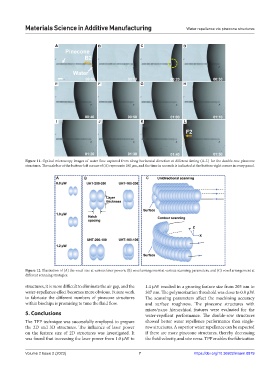
            Figure 11. Optical microscopy images of water flow captured from along horizontal direction at different timing (A–L) for the double-row pinecone
            structures. The scale bar at the bottom-left corner of (A) represents 100 μm, and the time in seconds is indicated at the bottom-right corner in every panel.

                         A           B                         C


            Figure 12. Illustration of (A) the voxel size at various laser powers; (B) voxel arrangement at various scanning parameters; and (C) voxel arrangement at
            different scanning strategies.

            structures, it is more difficult to eliminate the air gap, and the   1.4 μW resulted in a growing feature size from 203 nm to
            water-repellence effect becomes more obvious. Future work   307 nm. The polymerization threshold was close to 0.8 μW.
            to fabricate the different numbers of pinecone structures   The scanning parameters affect the machining accuracy
            within biochips is promising to tune the fluid flow.  and surface roughness. The pinecone structures with
                                                               micro/nano hierarchical features were evaluated for the
            5. Conclusions                                     water-repellent performance. The double-row structures

            The TPP technique was successfully employed to prepare   showed better water repellence performance than single-
            the 2D and 3D structures. The influence of laser power   row structures. A superior water repellence can be expected
            on the feature size of 2D structures was investigated. It   if there are more pinecone structures, thereby decreasing
            was found that increasing the laser power from 1.0 μW to   the fluid velocity, and vice versa. TPP enables the fabrication


            Volume 2 Issue 2 (2023)                         7                       https://doi.org/10.36922/msam.0879

