


Page 28 - MSAM-2-2
P. 28
Materials Science in Additive Manufacturing                         Water repellence via pinecone structures


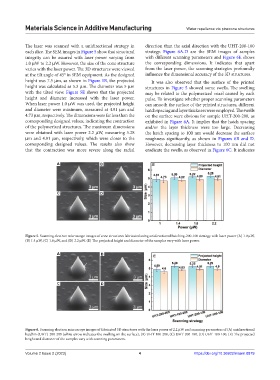
            The laser was scanned with a unidirectional strategy in   direction than the axial direction with the UHT-200-100
            each slice. The SEM images in Figure 5 show that structural   strategy.  Figure  6A-D  are the SEM images of samples
            integrity can be assured with laser power varying from   with different scanning parameters and Figure 6E shows
            1.0 μW to 2.2 μW. However, the size of the cone structure   the corresponding dimensions. It indicates that apart
            varies with the laser power. The 3D structures were viewed   from the laser power, the scanning strategies profoundly
            at the tilt angle of 45° in SEM equipment. As the designed   influence the dimensional accuracy of the 3D structures.
            height was 7.5 μm, as shown in Figure 1B, the projected   It was also observed that the surface of the printed
            height was calculated as 5.3 μm. The diameter was 5 μm   structures in Figure 5 showed some swells. The swelling
            with the tilted view.  Figure  5E shows that the projected   may be related to the polymerized voxel caused by each
            height and diameter increased with the laser power.   pulse. To investigate whether proper scanning parameters
            When laser power 1.0 μW was used, the projected height   can smooth the surface of the printed structures, different
            and diameter were minimum, measured at 4.91 μm and   hatch spacing and layer thickness were employed. The swells
            4.73 μm, respectively. The dimensions were far less than the   on the surface were obvious for sample UHT-200-200, as
            corresponding designed values, indicating the contraction   exhibited in Figure 6A. It implies that the hatch spacing
            of the polymerized structures. The maximum dimensions   and/or the layer thickness were too large. Decreasing
            were obtained with laser power 2.2 μW, measuring 5.28   the hatch spacing to 100 nm would decrease the surface
            μm and 4.91  μm, respectively, which were closer to the   roughness significantly, as shown in  Figures  6B  and  D.
            corresponding designed values. The results also show   However, decreasing layer thickness to 100  nm did not
            that the contraction was more severe along the radial   eradicate the swells, as observed in Figure 6C. It indicates


                         A                  B                     E


                         C                  D


            Figure 5. Scanning electron microscope images of cone structures fabricated using unidirectional hatching-200-100 strategy with laser power (A) 1.0 μW,
            (B) 1.4 μW, (C) 1.8 μW, and (D) 2.2 μW. (E) The projected height and diameter of the samples vary with laser power.


                         A                  B                     E


                         C                  D


            Figure 6. Scanning electron microscope images of fabricated 3D structures with the laser power of 2.2 μW and scanning parameters of (A) unidirectional
            hatchin (UHT)-200-200 (white arrow indicates the swelling on the surface), (B) UHT-100-200, (C) UHT-200-100, (D) UHT-100-100. (E) The projected
            height and diameter of the samples vary with scanning parameters.


            Volume 2 Issue 2 (2023)                         4                       https://doi.org/10.36922/msam.0879

