


Page 36 - MSAM-2-2
P. 36
Materials Science in Additive Manufacturing                  Tensile and fatigue properties of Ti6Al4V SLM parts


            2. Materials and methods                           Table 1. Nominal composition of Ti‑6Al‑4V (% by weight)

            2.1. Powder preparation                            Ti       Al      V    Fe  C   N  O   H   Others
                                                               Balance 5.50 – 6.50 3.50 – 4.50 0.25 0.08 0.03 0.13 0.013  0.5
            Plasma-atomized Ti6Al4V titanium powder with
            particle size distribution of 20 – 63  μm from SLM
            Solutions Group AG (Germany) was used. The chemical
            composition of the Ti6Al4V titanium alloy powder is
            listed in Table 1.

            2.2. SLM
            Ti6Al4V titanium alloy specimens in the project were
            fabricated using SLM 280 2.0 Twin 700 W AM machine
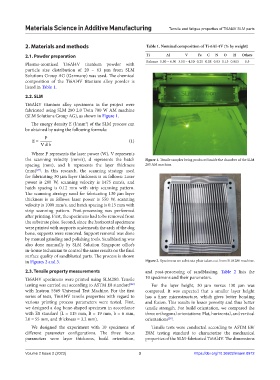
            (SLM Solutions Group AG), as shown in Figure 1.
              The energy density E (J/mm ) of the SLM process can
                                     3
            be obtained by using the following formula:
                    P
               E =                                      (1)
                  V d h
              Where P represents the laser power (W), V represents
            the scanning velocity (mm/s),  d represents the hatch   Figure 1. Tensile samples being produced inside the chamber of the SLM
            spacing (mm), and h represents the layer thickness   280 AM machine.
            (mm) .  In  this  research,  the  scanning  strategy  used
                [27]
            for fabricating 30 μm layer thickness is as follows: Laser
            power is 280 W, scanning velocity is 1475  mm/s, and
            hatch spacing is 0.12  mm with strip scanning pattern.
            The scanning strategy used for fabricating 130 μm layer
            thickness is as follows: laser power is  550 W, scanning
            velocity is 1000 mm/s, and hatch spacing is 0.15 mm with
            strip scanning pattern. Post-processing was performed
            after printing. First, the specimens had to be removed from
            the substrate plate. Second, since the horizontal specimens
            were printed with supports underneath the arch of the dog
            bone, supports were removed. Support removal was done
            by manual grinding and polishing tools. Sandblasting was
            also done manually by SLM Solution Singapore office’s
            in-house technician to control the same results on the final
            surface quality of sandblasted parts. The process is shown
            in Figures 2 and 3.                                Figure 2. Specimens on substrate plate taken out from SLM280 machine.
            2.3. Tensile property measurements                 and  post-processing  of  sandblasting.  Table  2  lists  the
            Ti6Al4V specimens were printed using SLM280. Tensile   10 specimens and their parameters.
            testing was carried out according to ASTM E8 standard    For the layer height, 30  μm versus 130  μm was
                                                        [28]
            with Instron 5569 Universal Test Machine. For the first   compared. It was expected that a smaller layer height
            series of tests, Ti6Al4V tensile properties with regard to   has a finer microstructure, which gives better bonding
            various printing process parameters were tested. First,   and fusion. This results in lesser porosity and thus better
            we designed a dog bone-shaped specimen in accordance   tensile strength. For build orientation, we compared the
            with E8 standard (L = 115 mm, B = 19 mm, b = 6 mm,   three orthogonal orientations: Flat, horizontal, and vertical
            L0 = 55 mm, and thickness = 3.2 mm).               orientations .
                                                                        [29]
              We designed the experiment with 10  specimens of   Tensile tests were conducted according to ASTM E8/
            different  parameter  configurations.  The  three  focus   E8M testing standard to characterize the mechanical
            parameters were layer thickness, build orientation,   properties of the SLM-fabricated Ti6Al4V. The dimensions


            Volume 2 Issue 2 (2023)                         3                       https://doi.org/10.36922/msam.0912

