


Page 41 - MSAM-2-2
P. 41
Materials Science in Additive Manufacturing                  Tensile and fatigue properties of Ti6Al4V SLM parts


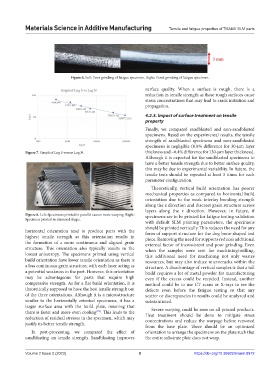
                               Figure 6. Left: Poor grinding of fatigue specimen. Right: Good grinding of fatigue specimen.

                                                               surface quality. When a surface is rough, there is a
                                                               reduction in tensile strength as these rough surfaces cause
                                                               stress concentrations that may lead to crack initiation and
                                                               propagation.

                                                               4.2.3. Impact of surface treatment on tensile
                                                               property

                                                               Finally, we compared sandblasted and non-sandblasted
                                                               specimens. Based on the experimental results, the tensile
                                                               strength of sandblasted specimens and non-sandblasted
                                                               specimens is negligible (0.8% difference for 30-μm layer
            Figure 7. Graph of Log S versus Log N.             thickness and −0.4% difference for 130-μm layer thickness).
                                                               Although it is expected for the sandblasted specimens to
                                                               have a better tensile strength due to better surface quality,
                                                               this may be due to experimental variability. In future, the
                                                               tensile tests should be repeated at least 3 times for each
                                                               parameter configuration.
                                                                 Theoretically, vertical build orientation has poorer
                                                               mechanical properties as compared to horizontal build
                                                               orientation due to the weak interlay bonding strength
                                                               along the z direction and discreet grain structure across
                                                               layers along the z direction. However, in future, if
            Figure 8. Left: Specimens printed in parallel causes more warping. Right:   specimens are to be printed for fatigue testing validation
            Specimen printed in diamond shape.
                                                               with default SLM printing parameters, the specimens
                                                               should be printed vertically. This reduces the need for any
            horizontal orientation tend to produce parts with the   form of support structure for the dog bone-shaped test
            highest  tensile  strength  as  this  orientation  results  in   piece. Removing the need for supports reduces additional
            the formation of a more continuous and aligned grain   external factor of inconsistent and poor grinding. Even
            structure. This orientation also typically results in the   when  the samples were  sent  for machining/milling,
            lowest  anisotropy. The  specimens printed using  vertical   this  additional  need  for  machining  not  only  wastes
            build orientation have lower tensile orientation as there is   resources, but may also induce microcracks within the
            a less continuous grain structure, with each layer acting as   structure. A disadvantage of vertical samples is that a tall
            a potential weakness in the part. However, this orientation   build requires a lot of metal powder for manufacturing
            may be advantageous for parts that require high    even if the excess could be recycled. Instead, another
            compressive strength. As for a flat build orientation, it is   method could be to use CT scans or X-rays to see the
            theoretically supposed to have the best tensile strength out   defects even before the fatigue testing so that any
            of the three orientations. Although it is a microstructure   scatter or discrepancies in results could be analyzed and
            similar to the horizontally oriented specimens, it has a   substantiated.
            larger surface area with the build plate, meaning that
                                                                 Severe warping could be seen on all printed products.
            there is faster and more even cooling . This leads to the   Heat treatment should be done to mitigate stress
                                          [29]
            reduction of residual stresses in the specimen, which may   concentrations and reduce the warpage before removed
            justify its better tensile strength.
                                                               from the base plate. There should be an optimized
              In post-processing, we compared the effect of    orientation to arrange the specimens on the plate such that
            sandblasting on tensile strength. Sandblasting improves   the entire substrate plate does not warp.


            Volume 2 Issue 2 (2023)                         8                       https://doi.org/10.36922/msam.0912

