


Page 39 - MSAM-2-2
P. 39
Materials Science in Additive Manufacturing                  Tensile and fatigue properties of Ti6Al4V SLM parts


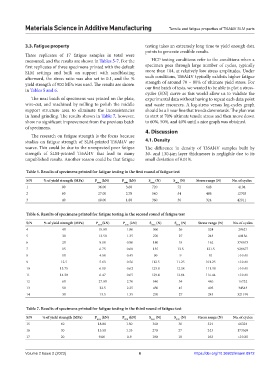
            3.3. Fatigue property                              testing takes an extremely long time to yield enough data
                                                               points to generate credible results.
            Three replicates of 17 fatigue samples in total were
            measured, and the results are shown in Tables 5-7. For the   HCF testing conditions refer to the conditions when a
            first replicates of three specimens printed with the default   specimen goes through large number of cycles, typically
            SLM  settings  and  built  on  support  with  sandblasting   more than 104, at relatively low stress amplitudes. Under
            afterward, the stress ratio was also set to 0.1, and the %   such conditions, Ti6Al4V typically exhibits higher fatigue
            yield strength of 900 MPa was used. The results are shown   strength of around 70 – 80% of ultimate yield stress. For
            in Tables 5 and 6.                                 our first batch of tests, we wanted to be able to plot a stress-
                                                               cycles (S/N) curve as this would allow us to validate the
              The next batch of specimens was printed on the plate,   experimental data without having to repeat each data point
            wire-cut, and machined by milling to polish the middle   and waste resources. A log-stress versus log-cycles graph
            support  structure area  to eliminate the  inconsistencies   should be a linear line that trends downwards. The plan was
            in hand grinding. The results shown in Table 7, however,   to start at 70% ultimate tensile stress and then move down
            show no significant improvement from the previous batch   to 60%, 50%, and 40% until a nice graph was obtained.
            of specimens.                                      4. Discussion
              The research on fatigue strength is the focus because
            studies on fatigue  strength of SLM-printed Ti6Al4V are   4.1. Density
            scarce. This could be due to the unexpected poor fatigue   The difference in density of Ti6Al4V samples built by
            strength of SLM-printed Ti6Al4V that lead to many   30- and 130-μm layer thicknesses is negligible due to its
            unpublished results. Another reason could be that fatigue   small deviation of 0.01%.

            Table 5. Results of specimens printed for fatigue testing in the first round of fatigue test
            S/N     % of yield strength (MPa)  P   (kN)  P  (kN)  S   (N)  S  (N)    Stress range (N)  No. of cycles
                                          max         min        max        min
            1              80              36.00       3.60       720        72          648          4104
            2              60              27.00       2.70       540        54          486          12703
            3              40              18.00       1.80       360        36          324          42011


            Table 6. Results of specimens printed for fatigue testing in the second round of fatigue test
            S/N     % of yield strength (MPa)  P  (kN)  P  (kN)  S   (N)   S  (N)    Stress range (N)  No. of cycles
                                           max        min        max        min
            4              40              18.00       1.80       360        36          324          29621
            5              30              13.50       1.35       270        27          243          60136
            6              20              9.00        0.90       180        18          162          370673
            7              15              6.75        0.68       135       13.5         121.5        929677
            8              10              4.50        0.45       90         9            81          >10 M
            9              12.5            5.63        0.56      112.5      11.25        101.25       >10 M
            10            13.75            6.19        0.62      123.8      12.38        111.38       >10 M
            11            14.38            6.47        0.65      129.4      12.94        116.44       >10 M
            12             60              27.00       2.70       540        54          486          16732
            13             50              22.5        2.25       450        45          405          34543
            14             30              13.5        1.35       270        27          243          321199

            Table 7. Results of specimens printed for fatigue testing in the third round of fatigue test

            S/N    % of yield strength (MPa)  P   (kN)  P  (kN)  S   (N)   S  (N)    Stress range (N)  No. of cycles
                                          max         min        max        min
            15             40              18.00       1.80       360        36          324          66324
            16             30              13.50       1.35       270        27          243          173569
            17             20              9.00        0.9        180        18          162          >10 M


            Volume 2 Issue 2 (2023)                         6                       https://doi.org/10.36922/msam.0912

