


Page 40 - MSAM-2-2
P. 40
Materials Science in Additive Manufacturing                  Tensile and fatigue properties of Ti6Al4V SLM parts


              During parameter optimization process, high energy   4.2.2. Impact of build orientation on tensile property
            density causes excessive melting of the layers and   The tensile strengths of different build orientations are
            balling . This happens when the molten metal does not   compared. The UTS of the vertical specimens was higher
                 [31]
            wet the substrate below due to surface tension, and hence   than that of the horizontal specimens when specimens
            results in balling. Therefore, high energy density does not   were printed with 30-μm layer thickness. First, post-
            necessarily increase the relative density of the material or   processing is one of the key root causes. The horizontal
            improve its quality. However, if the energy density is too   specimens had supports when printed and they had to
            low, the bond between each layer will not be good due to   be removed by manual polishing tools. However, such
            insufficient penetration depth .                   manual grinding may further propagate the poles or cracks
                                    [32]
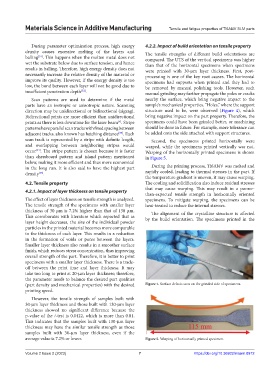
              Scan  patterns  are  used  to determine  if  the metal   nearby the surface, which bring negative impact to the
            parts  have  an  isotropic  or  anisotropic  nature.  Scanning   sample’s mechanical properties. “Holes,” where the support
            direction may be unidirectional or bidirectional (zigzag).   structure used to  be,  were observed  (Figure  4),  which
            Bidirectional prints are more efficient than unidirectional   bring negative impact on the part property. Therefore, the
            prints as there is less downtime for the laser beam . Stripe   specimens could have been grinded better, or machining
                                                   [4]
            patterns have parallel scan tracks with fixed spacing between   should be done in future. For example, more tolerance can
            adjacent tracks, also known has hatching distance . Each   be added onto the side attached with support structures.
                                                   [33]
            scan track is represented by a stripe with definite length,   Second, the specimens printed horizontally were
            and overlapping between neighboring stripes would   warped, while the specimens printed vertically was not.
            occur . The stripe pattern is chosen because it is faster   Warping of the horizontally printed specimens is shown
                [34]
            than  chessboard  pattern  and island  pattern mentioned   in Figure 5.
            below, making it more efficient and thus more economical
            in the long run. It is also said to have the highest part   During the printing process, Ti6Al4V was melted and
                  [35]
            density .                                          rapidly cooled, leading to thermal stresses in the part. If
                                                               the temperature gradient is uneven, it may cause warping.
            4.2. Tensile property                              The cooling and solidification also induce residual stresses
                                                               that may cause warping. This may result in a poorer-
            4.2.1. Impact of layer thickness on tensile property
                                                               than-expected tensile strength in horizontally oriented
            The effect of layer thickness on tensile strength is analyzed.   specimens. To mitigate warping, the specimens can be
            The tensile strength of the specimens with smaller layer   heat-treated to reduce the internal stresses.
            thickness of 30 μm is 7.2% higher than that of 130 μm.   The  alignment  of  the  crystalline  structure  is  affected
            This corroborates with literature which reported that as   by the build orientation. The specimens printed in the
            layer height decreases, the size of the individual powder
            particles in the printed material becomes more comparable
            to the thickness of each layer. This results in a reduction
            in the formation of voids or pores between the layers.
            Smaller layer thickness also results in a smoother surface
            finish, which reduces stress concentration, thus improving
            overall strength of the part. Therefore, it is better to print
            specimens with a smaller layer thickness. There is a trade-
            off between the print time and layer thickness. It may
            take too long to print at 20-μm layer thickness; therefore,
            the parameter needs to balance the desired part qualities
            (part density and mechanical properties) with the desired   Figure 4. Surface defects seen on the grinded side of specimens.
            printing speed.
              However, the tensile strength of samples built with
            30-μm layer thickness and those built with 130-μm layer
            thickness showed  no significant  difference  because  the
            p-value of the t-test is 0.0422, which is more than 0.01.
            This indicates that the samples built with 130-μm layer
            thickness may have the similar tensile strength as those
            samples built with 30-μm layer thickness, even if the
            average value is 7.2% or lower.                    Figure 5. Warping of horizontally printed specimen.


            Volume 2 Issue 2 (2023)                         7                       https://doi.org/10.36922/msam.0912

