


Page 42 - MSAM-2-2
P. 42
Materials Science in Additive Manufacturing                  Tensile and fatigue properties of Ti6Al4V SLM parts


                         A


                         B


                         C


                         D


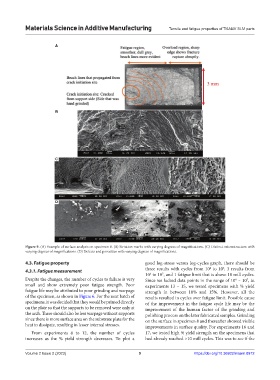
            Figure 9. (A) Example of surface analysis on specimen 8. (B) Striation marks with varying degrees of magnifications. (C) Distinct microstructure with
            varying degrees of magnifications. (D) Defects and porosities with varying degrees of magnifications.

            4.3. Fatigue property                              good log-stress versus log-cycles graph, there should be
                                                                                                6
                                                                                          4
                                                               three results with cycles from 10  to 10 , 3 results from
            4.3.1. Fatigue measurement
                                                               10  to 10 , and 1 fatigue limit that is above 10 mill cycles.
                                                                 6
                                                                      7
            Despite the changes, the number of cycles to failure is very   Since we lacked data points in the range of 10  – 10 , in
                                                                                                          7
                                                                                                     6
            small  and  show  extremely  poor  fatigue  strength.  Poor   experiments 13 – 15, we tested specimens with % yield
            fatigue life may be attributed to poor grinding and warpage   strength in between 10% and 15%. However, all the
            of the specimen, as shown in Figure 6. For the next batch of   results resulted in cycles over fatigue limit. Possible cause
            specimens, it was decided that they would be printed directly   of the improvement in the fatigue cycle life may be the
            on the plate so that the supports to be removed were only at   improvement of the human factor of the grinding and
            the arch. There should also be less warpage without supports   polishing process on the later fabricated samples. Grinding
            since there is more surface area on the substrate plate for the   on the surface in specimen 8 and thereafter showed visible
            heat to dissipate, resulting in lesser internal stresses.  improvements in surface quality. For experiments 16 and
              From experiments 8 to 12, the number of cycles   17, we tested high % yield strength on the specimens that
            increases as the % yield strength decreases. To plot a   had already reached >10 mill cycles. This was to see if the

            Volume 2 Issue 2 (2023)                         9                       https://doi.org/10.36922/msam.0912

