


Page 49 - MSAM-2-2
P. 49
Materials Science in Additive Manufacturing                          Biomimetic structures for optical focusing


                         A


                         B


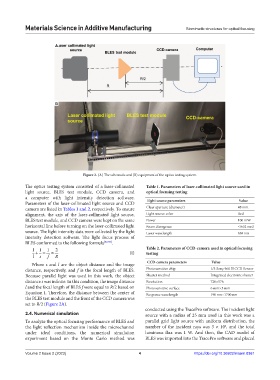
                                    Figure 2. (A) The schematic and (B) equipment of the optics testing system.

            The optics testing system consisted of a laser-collimated   Table 1. Parameters of laser‑collimated light source used in
            light source, BLES test module, CCD camera, and    optical focusing testing
            a computer with light intensity detection software.
            Parameters of the laser-collimated light source and CCD   Light source parameters          Value
            camera are listed in Tables 1 and 2, respectively. To ensure   Clear aperture (diameter)  48 mm
            alignment, the axis of the laser-collimated light source,   Light source color            Red
            BLES test module, and CCD camera were kept on the same   Power                            100 mW
            horizontal line before turning on the laser-collimated light   Beam divergence            ≤0.02 mrd
            source. The light intensity data were collected by the light   Laser wavelength           638 nm
            intensity detection software. The light focus process of
            BLES conformed to the following formula [32,33] .
               11    1    2                            (I)    Table 2. Parameters of CCD‑camera used in optical focusing

                                                               testing
               l  s  f   R
                                                                CCD‑camera parameters      Value
              Where  s and  l are the object distance and the image
            distance, respectively, and  f is the  focal length of BLES.   Photosensitive chip  1/3 Sony 960 H CCD Sensor
            Because parallel light was used in this work,  the object   Shutter method     Integrated electronic shutter
            distance s was infinite. In this condition, the image distance   Resolution    720×576
            l and the focal length of BLES f were equal to R/2 based on   Photosensitive surface  6 mm×5 mm
            Equation I. Therefore, the distance between the center of   Response wavelength  190 nm~1700 nm
            the BLES test module and the front of the CCD camera was
            set to R/2 (Figure 2A).
                                                               conducted using the TracePro software. The incident light
            2.4. Numerical simulation                          source with a radius of 25 mm used in this work was a

            To analyze the optical focusing performance of BLES and   parallel grid light source with uniform distribution, the
                                                                                                 6
            the light reflection mechanism inside the microchannel   number of the incident rays was 3 × 10 , and the total
            under  ideal  conditions,  the  numerical  simulation   luminous  flux  was  1  W.  And  then,  the  CAD  model  of
            experiment  based  on  the  Monte  Carlo  method  was   BLES was imported into the TracePro software and placed


            Volume 2 Issue 2 (2023)                         4                       https://doi.org/10.36922/msam.0361

