


Page 52 - MSAM-2-2
P. 52
Materials Science in Additive Manufacturing                          Biomimetic structures for optical focusing


                         A                      B                        C


                         D                      E                        F


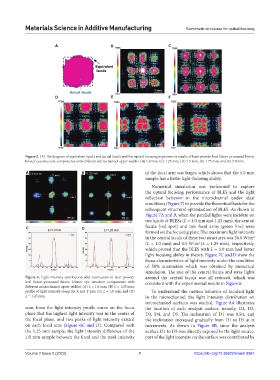
            Figure 5. (A) The diagram of equivalent facula and actual facula and the optical focusing experiments results of laser powder bed fusion-processed bionic
            lobster eye structure components with different microchannel upper widths: (B) 1.0 mm, (C) 1.25 mm, (D) 1.5 mm, (E) 1.75 mm, and (F) 2.0 mm.

            A                       B                          of the focal arm was larger, which shows that the 1.0 mm
                                                               sample has a better light-focusing ability.
                                                                 Numerical simulation was performed to explore
                                                               the optical focusing performance of BLES and the light
                                                               reflection behavior in the microchannel under ideal
                                                               conditions (Figure 7) to provide the theoretical basis for the
                                                               subsequent structural optimization of BLES. As shown in
                                                               Figure 7A and B, when the parallel lights were incident on
                                                               two kinds of BLESs (L = 1.0 mm and 1.25 mm), the central
            C                       D                          facula (red spot) and two focal arms (green line) were
                                                               formed on the focusing plate. The maximum light intensity
                                                               in the central facula of these two structures was 26.0 W/m
                                                                                                             2
                                                               (L = 1.0 mm) and 4.5 W/m (L = 1.25 mm), respectively,
                                                                                     2
                                                               which proved that the BLES with L = 1.0 mm had better
                                                               light-focusing ability in theory. Figure 7C and D show the
                                                               focus characteristics of light intensity under the condition
                                                               of 50% attenuation which was obtained by numerical
                                                               simulation. The size of the central facula and stray lights
            Figure 6. Light intensity distribution after attenuation of laser powder   around the central facula was all reduced, which was
            bed  fusion-processed  bionic  lobster  eye  structure  components  with   consistent with the experimental results in Figure 6.
            different microchannel upper widths: (A) L = 1.0 mm, (B) L = 1.25 mm;
            profile of light intensity along the X and Y axis: (C) L = 1.0 mm, and (D)   To understand the motion behavior of incident light
            L = 1.25 mm.                                       in the microchannel, the light intensity distribution on
                                                               microchannel surfaces was studied. Figure 8A illustrates
            seen from the light intensity profile curve on the focus   the location of each analysis surface, namely, D1, D2,
            plane that the highest light intensity was in the center of   D3, D4, and D5. The inclination of D1 was 0.5α, and
            the focal plane, and two peaks of light intensity existed   the inclination increased gradually from D1 to D5 at  α
            on each focal arm (Figure  6C  and  D). Compared with   increments. As shown in  Figure  8B, since the analysis
            the 1.25 mm sample, the light intensity difference of the   surface D1 to D5 was directly exposed to the light source,
            1.0 mm sample between the focal and the peak intensity   part of the light intensity on the surface was contributed by


            Volume 2 Issue 2 (2023)                         7                       https://doi.org/10.36922/msam.0361

