


Page 60 - MSAM-2-2
P. 60
Materials Science in Additive Manufacturing                  Cellulose microfiber in ABS filament for 3D printing


            3. Data and methods

            This work presents considerations about a comparative
            study between the mechanical properties of test specimens
            formed by 3D-printing processing, using pure ABS and
            ABS composite with highly crystalline cellulose additive.

            3.1. Preparation of crystalline cellulose microfiber
            The preparation  of crystalline  cellulose microfibers was
            carried out from samples of  E.  grandis, certified by the
            FSC, which were manually ground and dried at 110°C for
            24 h in laboratory oven. The ground and dehydrated wood
            was then subjected to acid hydrolysis, according to the
                                                    [36]
                              [35]
            procedure by Qu et al.  and Sanchez and Terence .
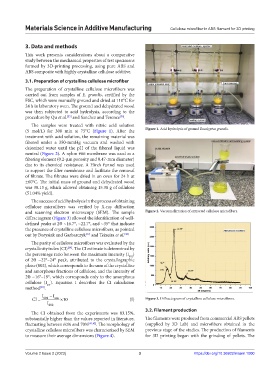
              The  samples  were  treated  with  nitric  acid  solution
            (5 mol/L) for 300  min at 75°C (Figure  1). After the   Figure 1. Acid hydrolysis of ground Eucalyptus grandis.
            treatment with acid solution, the remaining material was
            filtered under a 350-mmHg vacuum and washed with
            deionized water until the pH of the filtered liquid was
            neutral (Figure 2). A nylon #66 membrane was used as a
            filtering element (0.2-µm porosity and 0.47-mm diameter)
            due to its chemical resistance. A Hirch funnel was used
            to support the filter membrane and facilitate the removal
            of filtrate. The filtrates were dried in an oven for 24 h at
            ±60°C. The initial mass of ground and dehydrated wood
            was 30.13 g, which allowed obtaining 15.38 g of cellulose
            (51.04% yield).

              The success of acid hydrolysis in the process of obtaining
            cellulose microfibers was verified by X-ray diffraction
            and scanning electron  microscopy  (SEM).  The sample   Figure 2. Vacuum filtration of extracted cellulose microfibers.
            diffractogram (Figure 3) allowed the identification of well-
            defined peaks at 2ϴ ~16.7°, ~22.7°, and ~35° that indicate
            the presence of crystalline cellulose microfibers, as pointed
            out by Borysiak and Garbarczyk  and Teixeira et al. [38]
                                     [37]
              The purity of cellulose microfibers was evaluated by the
            crystallinity index (CI) . The CI estimate is determined by
                              [39]
            the percentage ratio between the maximum intensity (I )
                                                        002
            of 2ϴ ~22°–24° peak, attributed to the crystallographic
            plane (002), which corresponds to the sum of the crystalline
            and amorphous fractions of cellulose, and the intensity of
            2ϴ ~16°–19°, which corresponds only to the amorphous
            cellulose (I ). Equation I describes the CI calculation
                     am
                  [40]
            method .
                   I   I
               CI   002  am  10                       (I)    Figure 3. Diffractogram of crystalline cellulose microfibers.
                     I 002
                                                               3.2. Filament production
              The CI obtained from the experiments was 83.15%,
            substantially higher than the values reported in literature,   The filaments were produced from commercial ABS pellets
            fluctuating between 60% and 70% [41,42] . The morphology of   (supplied by 3D Lab) and microfibers obtained in the
            crystalline cellulose microfibers was characterized by SEM   previous stage of the studies. The production of filaments
            to measure their average dimensions (Figure 4).    for 3D printing began with the grinding of pellets. The


            Volume 2 Issue 2 (2023)                         3                       https://doi.org/10.36922/msam.1000

