


Page 61 - MSAM-2-2
P. 61
Materials Science in Additive Manufacturing                  Cellulose microfiber in ABS filament for 3D printing


            increased surface  area  favors mixing with microfibers.
            After grinding (in a knife mill), the material was divided
            into two equal masses. One in which pure ABS filaments
            will be produced and the other in which crystalline
            cellulose microfiber will be added. The ABS was spiked
            with 0.5% (in weight) of crystalline cellulose microfibers.
              An extruder with a pulling mechanism was used to
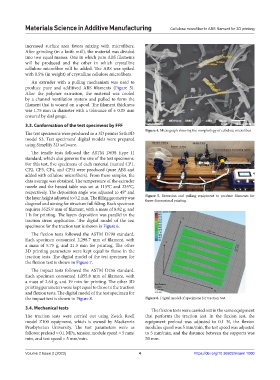
            produce  pure  and  additived  ABS  filaments  (Figure  5).
            After the polymer extrusion, the material was cooled
            by a channel ventilation system and pulled to form the
            filament that is wound on a spool. The filament thickness
            was 1.75 mm in diameter with a tolerance of ± 0.05 mm
            ensured by dial gauge.
            3.3. Conformation of the test specimens by FFF
                                                               Figure 4. Micrograph showing the morphology of cellulose microfiber.
            The test specimens were produced in a 3D printer Sethi3D
            model S3. Test specimens’ digital models were prepared
            using Simplify 3D software.
              The tensile tests followed the ASTM D638 (type  1)
            standard, which also governs the size of the test specimens.
            For this test, five specimens of each material (named CP1,
            CP2, CP3, CP4, and CP5) were produced (pure ABS and
            added with cellulose microfibers). From these samples, the
            data average was obtained. The temperature of the extruder
            nozzle and the heated  table was set at 115°C and 235°C,
            respectively. The deposition angle was adjusted to 45° and
            the layer height adjusted to 0.2 mm. The filling geometry was   Figure  5. Extrusion and pulling equipment to produce filaments for
                                                               three-dimensional printing.
            diagonal and aiming for structure full filling. Each specimen
            requires 3525.9 mm of filament, with a mass of 8.82 g, and
            1 h for printing. The layers deposition was parallel to the
            traction stress application. The digital model of the test
            specimens for the traction test is shown in Figure 6.
              The flexion tests followed the ASTM D790 standard.
            Each specimen consumed 2,298.7  mm of filament, with
            a mass of 5.75  g, and 21.5  min for printing. The other
            3D printing parameters were kept equal to  those in the
            traction tests. The digital model of the test specimen for
            the flexion test is shown in Figure 7.
              The impact tests followed the ASTM D256 standard.
            Each specimen consumed 1,055.8  mm of filament, with
            a mass of 2.64 g, and 19 min for printing. The other 3D
            printing parameters were kept equal to those in the traction
            and flexion tests. The digital model of the test specimen for
            the impact test is shown in Figure 8.              Figure 6. Digital model of specimens for traction test.

            3.4. Mechanical tests                                The flexion tests were carried out in the same equipment
            The traction tests were carried out using Zwick Roell   that performs the traction test.  In the flexion  test, the
            model  Z100  equipment,  which  is  owned  by  Mackenzie   equipment preload was adjusted to 0.1 N, the flexion
            Presbyterian University. The test parameters were as   modulus speed was 5 mm/min, the test speed was adjusted
            follows: preload = 0.1 MPa, tension module speed = 5 mm/  to 5 mm/min, and the distance between the supports was
            min, and test speed = 5 mm/min.                    50 mm.


            Volume 2 Issue 2 (2023)                         4                       https://doi.org/10.36922/msam.1000

