


Page 62 - MSAM-2-2
P. 62
Materials Science in Additive Manufacturing                  Cellulose microfiber in ABS filament for 3D printing


              The equipment used in the impact tests was the Izod   requires fixing the specimen in a vertical position with
            pattern by Tinius Olsen, which is owned by Mackenzie   the “V” notch positioned in a guide that guarantees the
            Presbyterian University. The test in the Izod pattern   fixing precision. The load was applied instantaneously
                                                               by releasing a pendular hammer initially launched at a
                                                               height “h .” After the release and the impact with the test
                                                                      0
                                                               specimen, the hammer continues its course up to a height
                                                               “h ,” which is less than “h .” The energy absorption by the
                                                                                   0
                                                                 f
                                                               test specimen is calculated from the difference between
                                                               “h ” and “h .” The impact speed was calibrated at 3.45 m/s.
                                                                        f
                                                                 0
                                                                 The melt flow index test was carried out using a Tinius
                                                               Olsen extrusion plastometer at Mackenzie Presbyterian
                                                               University. The tests followed the ASTM D1238 standard.
                                                               The equipment to evaluate the melt flow index consists of
                                                               a heated chamber, where the polymer is placed to melt.
                                                               Over the chamber, a standardized piston forces the molten
                                                               polymer to flow through a capillary with standardized
                                                               dimensions. The polymer melting was performed at 200°C
                                                               and a load of 5.0 kg. The melting masses of the samples
            Figure 7. Digital model of specimens for flexion test.  were collected, and the results were obtained in the unit
                                                               of g/10 min.

                                                               4. Results
                                                               4.1. Traction test
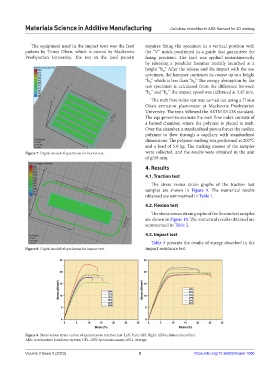
                                                                 The  stress  versus  strain  graphs  of the traction  test
                                                               samples are shown in  Figure  9. The numerical results
                                                               obtained are summarized in Table 1.

                                                               4.2. Flexion test
                                                                 The stress versus strain graphs of the flexion test samples
                                                               are shown in Figure 10. The numerical results obtained are
                                                               summarized in Table 2.

                                                               4.3. Impact test
                                                                 Table 3 presents the results of energy absorbed in the
            Figure 8. Digital model of specimens for impact test.  impact resistance test.


            Figure 9. Stress versus strain curves of specimens in traction test. Left: Pure ABS; Right: ABS/cellulose microfiber.
            ABS: Acrylonitrile butadiene styrene; CP1–CP5: Specimens name; AVG: Average.

            Volume 2 Issue 2 (2023)                         5                       https://doi.org/10.36922/msam.1000

