


Page 63 - MSAM-2-2
P. 63
Materials Science in Additive Manufacturing                  Cellulose microfiber in ABS filament for 3D printing


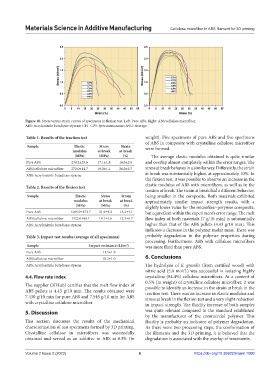
            Figure 10. Stress versus strain curves of specimens in flexion test. Left: Pure ABS; Right: ABS/cellulose microfiber.
            ABS: Acrylonitrile butadiene styrene; CP1–CP5: Specimens name; AVG: Average.

            Table 1. Results of the traction test              weight). Five specimens of pure ABS and five specimens
                                                               of ABS in composite with crystalline cellulose microfiber
             Sample              Elastic   Stress   Strain     were formed.
                                modulus    at break   at break
                                 (MPa)     (MPa)     (%)         The  average  elastic  modulus  obtained  is  quite  similar
            Pure ABS           274.2±25.6  17.1±1.8  16.0±2.6  and overlap almost completely within the error ranges. The
            ABS/cellulose microfiber  272.0±14.7  19.0±1.1  26.0±2.7  stress at break behaves in a similar way. Differently, the strain
            ABS: Acrylonitrile butadiene styrene               at break was substantially higher, at approximately 10%. In
                                                               the flexion test, it was possible to observe an increase in the
                                                               elastic modulus of ABS with microfibers, as well as in the
            Table 2. Results of the flexion test
                                                               tension at break. The strain at break had a different behavior,
             Sample              Elastic    Stress   Strain    being smaller in the composite. Both materials exhibited
                                modulus    at break   at break   approximately similar impact strength results, with a
                                 (MPa)      (MPa)     (%)      slightly lower value for the microfiber-polymer composite,
            Pure ABS           1285.0±173.7  11.9±3.3  15.2±3.1  but equivalent within the experiment’s error range. The melt
            ABS/cellulose microfiber  1522.0±98.1  14.1±5.6  12.3±0.7  flow index of both materials (7 g/10 min) is substantially
            ABS: Acrylonitrile butadiene styrene               higher than that of the ABS pellets (4.43 g/10 min). This
                                                               indicates a decrease in the polymer molar mass. There was
            Table 3. Impact test results (average of all specimens)  probably degradation in the polymer properties during
                                                               processing. Furthermore, ABS with cellulose microfibers
             Sample                    Impact resistance (kJ/m )  was more fluid than pure ABS.
                                                       2
            Pure ABS                         11.5±1.9
            ABS/cellulose microfiber         10.2±1.0          6. Conclusions
            ABS: Acrylonitrile butadiene styrene               The  hydrolysis  of  E. grandis  (from  certified  wood)  with
                                                               nitric acid (5.0 mol/L) was successful in isolating highly
            4.4. Flow rate index                               crystalline (84.4%) cellulose microfibers. At a content of
                                                               0.5% (in weight) of crystalline cellulose microfiber, it was
            The supplier (3DLab) certifies that the melt flow index of   possible to identify an increase in the strain at break in the
            ABS pellets is 4.43  g/10  min. The results obtained were   traction test. There was an increase in elastic modulus and
            7.430 g/10 min for pure ABS and 7.546 g/10 min for ABS   stress at break in the flexion test and a very slight reduction
            with crystalline cellulose microfiber.             in impact strength. The fluidity increase of both samples
            5. Discussion                                      was quite relevant compared to the standard established
                                                               by the manufacturer of the commercial polymer. This
            This section discusses the results of the mechanical   fluidity is probably an indicator of polymer degradation.
            characterization of test specimens formed by 3D printing.   As there were two processing steps, the conformation of
            Crystalline  cellulose  in  microfibers  was  successfully   the filaments and the 3D printing, it is believed that the
            obtained and served as an additive to ABS at 0.5% (in   degradation is associated with the overlap of treatments.


            Volume 2 Issue 2 (2023)                         6                       https://doi.org/10.36922/msam.1000

