


Page 22 - MSAM-3-3
P. 22
Materials Science in Additive Manufacturing                           Defects in additively fabricated Al6061


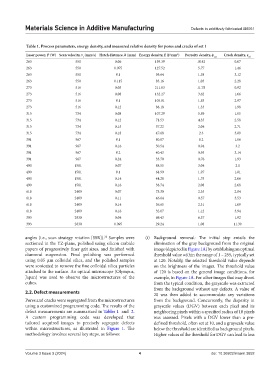
            Table 1. Process parameters, energy density, and measured relative density for pores and cracks of set 1
            Laser power, P (W) Scan velocity, v  (mm/s) Hatch distance, h (mm) Energy density, E (J/mm )  Porosity density, ϕ  Crack density, ε
                                                                            3
                                    s                                                       rel            rel
            263                  550              0.06             159.39            10.42           0.67
            263                  550              0.075            127.52            5.77            1.46
            263                  550              0.1              95.64             1.58            3.12
            263                  550              0.115            83.16             1.03            2.28
            273                  516              0.05             211.63            11.78           0.92
            273                  516              0.08             132.27            3.62            1.66
            273                  516              0.1              105.81            1.83            2.97
            273                  516              0.12             88.18             1.33            1.98
            315                  734              0.08             107.29            5.89            1.05
            315                  734              0.12             71.53             4.35            2.58
            315                  734              0.15             57.22             2.04            2.71
            315                  734              0.18             47.68              2.3            3.89
            391                  967              0.1              80.87              8.2            1.06
            391                  967              0.16             50.54             0.94            3.2
            391                  967              0.2              40.43             0.95            3.14
            391                  967              0.24             33.70             0.76            1.93
            490                  1581             0.07             88.55             3.04            2.1
            490                  1581             0.1              61.99             1.97            1.81
            490                  1581             0.14             44.28             1.75            2.66
            490                  1581             0.16             38.74             2.08            2.68
            618                  2409             0.07             73.30             2.35            2.84
            618                  2409             0.11             46.64             0.57            3.53
            618                  2409             0.14             36.65             2.31            1.69
            618                  2409             0.16             32.07             1.12            3.94
            393                  2830             0.04             69.43             6.37            1.92
            393                  2830             0.095            29.24             1.08           11.39

            angles (i.e., scan strategy rotation [SSR]).  Samples were   (i)  Background removal: The initial step entails the
                                             22
            sectioned in the YZ-plane, polished using silicon carbide   elimination of the gray background from the original
            papers of progressively finer grit sizes, and finished with   image (depicted in Figure 1A) by establishing an optimal
            diamond suspension. Final polishing was performed     threshold value within the range of 1 – 255, typically set
            using 0.05 µm colloidal silica, and the polished samples   at 120. Notably, the selected threshold value depends
            were sonicated to remove the fine colloidal silica particles   on the brightness of the images. The threshold value
            attached to the surface. An optical microscope (Olympus,   of 120 is based on  the general image conditions,  for
            Japan) was used to observe the microstructures of the   example, in Figure 1A. For other images that may divert
            cubes.                                                from the typical condition, the grayscale was extracted
                                                                  from the background without any defects. A value of
            2.2. Defect measurements                              20 was then added to accommodate any variations
            Pores and cracks were segregated from the microstructures   from the background. Concurrently, the disparity in
            using a customized programming code. The results of the   grayscale  values  (DGV)  between  each  pixel  and  its
            defect measurements are summarized in Tables 1  and  2.   neighboring pixels within a specified radius of 10 pixels
            A  custom programming code was developed that         was  assessed.  Pixels  with  a  DGV  lower  than  a  pre-
            tailored  acquired  images to precisely  segregate defects   defined threshold, often set at 10, and a grayscale value
            within microstructures, as illustrated in  Figure  1. The   below the threshold are identified as background pixels.
            methodology involves several key steps, as follows:   Higher values of the threshold for DGV can lead to less


            Volume 3 Issue 3 (2024)                         4                              doi: 10.36922/msam.3652

