


Page 27 - MSAM-3-3
P. 27
Materials Science in Additive Manufacturing                           Defects in additively fabricated Al6061


                         A                       B                       C


                         D                       E                       F


                         G                       H                        I


                         J                       K                       L


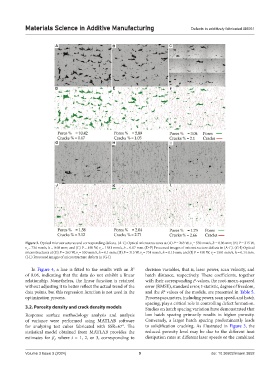
            Figure 3. Optical microstructures and corresponding defects. (A-C) Optical microstructures at (A) P = 263 W, v = 550 mm/s, h = 0.06 mm; (B) P = 315 W,
                                                                                   s
            v = 734 mm/s, h = 0.08 mm; and (C) P = 490 W, v = 1581 mm/s, h = 0.07 mm. (D-F) Processed images of microstructure defects in (A-C). (G-I) Optical
             s
                                            s
            microstructures at (G) P = 263 W, v = 550 mm/s, h = 0.1 mm; (H) P = 315 W, v = 734 mm/s, h = 0.15 mm; and (I) P = 490 W, v = 1581 mm/s, h = 0.14 mm.
                                                                                           s
                                  s
                                                             s
            (J-L) Processed images of microstructure defects in (G-I)
              In  Figure  4, a line is fitted to the results with an  R    decision variables, that is, laser power, scan velocity, and
                                                          2
            of 0.06, indicating  that the data do not exhibit a linear   hatch distance, respectively. These coefficients, together
            relationship. Nonetheless, the  linear  function is retained   with their corresponding P-values, the root-mean-squared
            without adjusting it to better reflect the actual trend of the   error (RMSE), standard error, t-statistic, degree of freedom,
            data points, but this regression function is not used in the   and the R  values of the models, are presented in Table 5.
                                                                       2
            optimization process.                              Process parameters, including power, scan speed, and hatch
                                                               spacing, play a critical role in controlling defect formation.
            3.2. Porosity density and crack density models     Studies on hatch spacing variation have demonstrated that
            Response surface methodology analysis and analysis   low hatch spacing primarily results in higher porosity.
            of variance were performed using MATLAB software   Conversely, a larger hatch spacing predominantly leads
            for analyzing test cubes fabricated with SSR=67°. The   to solidification cracking. As illustrated in  Figure  3, the
            statistical model obtained from  MATLAB  provides  the   reduced  porosity  level  may  be  due  to  the  different  heat
            estimates for  β , where  i  = 1, 2, or 3, corresponding to   dissipation rates at different laser speeds or the combined
                        i

            Volume 3 Issue 3 (2024)                         9                              doi: 10.36922/msam.3652

