


Page 30 - MSAM-3-3
P. 30
Materials Science in Additive Manufacturing                           Defects in additively fabricated Al6061


            A                               B                               C


            D                               E                                F


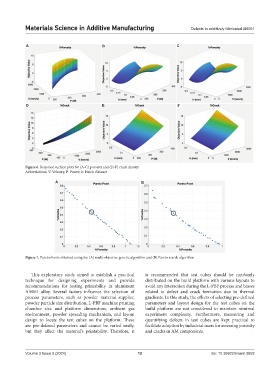
            Figure 6. Response surface plots for (A-C) porosity and (D-F) crack density
            Abbreviations: V: Velocity; P: Power; h: Hatch distance

                         A                                   B


            Figure 7. Pareto fronts obtained using the (A) multi-objective genetic algorithm and (B) Pareto search algorithm


              This exploratory study aimed to establish a practical   is recommended that test cubes should be randomly
            technique  for  designing  experiments  and  provide   distributed on the build platform with various layouts to
            recommendations for testing printability in aluminum   avoid any interaction during the L-PBF process and biases
            Al6061 alloy. Several factors influence the selection of   related to defect and crack formation due to thermal
            process parameters, such as powder material supplier,   gradients. In this study, the effects of selecting pre-defined
            powder particle size distribution, L-PBF machine printing   parameters and layout design for the test cubes on the
            chamber size and platform dimensions, ambient gas   build  platform  are  not  considered  to  maintain  minimal
            environment, powder spreading mechanism, and layout   experiment complexity. Furthermore, measuring and
            design to locate the test cubes on the platform. These   quantifying defects in test cubes are kept practical to
            are pre-defined parameters and cannot be varied easily,   facilitate adoption by industrial users for assessing porosity
            but they affect the material’s printability. Therefore, it   and cracks in AM components.


            Volume 3 Issue 3 (2024)                         12                             doi: 10.36922/msam.3652

