


Page 28 - MSAM-3-3
P. 28
Materials Science in Additive Manufacturing                           Defects in additively fabricated Al6061


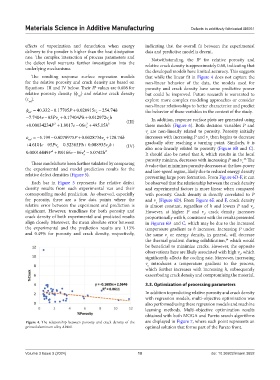
            effects of vaporization and denudation when energy   indicating  that  the  overall  fit  between  the  experimental
            delivery to the powder is higher than the heat dissipation   data and predictive model is decent.
            rate. The complex interaction of process parameters and   Notwithstanding, the  R  for relative porosity and
                                                                                      2
            the defect level warrants further investigation into the   relative crack density is approximately 0.68, indicating that
            underlying mechanisms.
                                                               the developed models have limited accuracy. This suggests
              The  resulting  response  surface  regression  models   that while the linear fit in Figure 4 does not capture the
            for the relative porosity and crack density are based on   non-linear behavior of the data, the models used for
            Equations  III and IV below. Their R  values are 0.608 for   porosity and crack density have some predictive power
                                         2
            relative porosity density (ϕ ) and relative crack density   but could be improved. Future research is warranted to
                                  rel
            (ε ).                                              explore more complex modeling approaches or consider
             rel
                                                               non-linear relationships to better characterize and predict
             rel   40 332 0 17705.   .  P  0 020915 v  254 74 h  the behavior of these variables in the context of the study.
                                   .
                                               .
                                          s
            7 7404.  e  05 Pv  017.  4 404Ph   0 012972vh.  s  (III)  In addition, response surface plots are generated using
                          s
             0 00034234P .  2  1 8017e .  06v  495 15h 2   these  models  (Figure  6). Both decision variables  P  and
                                      2
                                           .
                                      s
                                                               v   are  non-linearly  related to  porosity.  Porosity  initially
                                                                s
             rel  5 199 0 0070975.   .  P  0 0028734 v 120 74 h  increases with increasing P and v  then begins to decrease
                                     .
                                                  .
                                             s
                                                                                          s
            4 6101.  e  05 Pv  0..52365Ph   . 0 088935vh    (IV)  gradually after  reaching  a  turning  point.  Similarly,  h  is
                                               s
                         s
                                                               also non-linearly related to porosity (Figure  6B  and  C).
             . 0 00014449P  .3 0166e  06v   . 5 0742h 2    It should also be noted that h, which results in the local
                                     2
                       2
                                     s
                                                               porosity minima, decreases with increasing P and v  The
                                                                                                         33
                                                                                                        s.
              These models have been further validated by comparing   h value that minimizes porosity decreases at the low-power
            the experimental and model prediction results for the   and low-speed region, likely due to reduced energy density
            relative defect densities (Figure 5).              preventing large pore formation. From Figure 6D‑F, it can
              Each bar in  Figure  5 represents the relative defect   be observed that the relationship between the crack density
            density results from each experimental run and their   and experimental factors is more linear when compared
            corresponding model prediction. As observed, especially   with porosity. Crack density is directly correlated to  P
            for porosity, there are a few data points where the   and v  (Figure 6D). From Figure 6E and F, crack density
                                                                   s
            relative error between the experiment and prediction is   is almost constant, regardless of  h and lowers  P  and  v .
                                                                                                            s
            significant. However, trendlines for both porosity and   However, at higher  P and  v , crack density increases
                                                                                        s
            crack density of both experimental and predicted results   proportionally with h, consistent with the results presented
            align closely. Moreover, the mean absolute error between   in Figures 6B  and C, which may be due to the increased
            the  experimental  and  the  prediction  results  are  1.13%   temperature gradient  as  h increases. Increasing  P  under
            and  0.49%  for  porosity  and  crack  density,  respectively,   the same  v  or energy density, in general, will decrease
                                                                        s
                                                               the thermal gradient during solidification,  which would
                                                                                                 34
                                                               be beneficial to minimize cracks. However, the opposite
                                                               observations here are likely associated with high v , which
                                                                                                       s
                                                               significantly affects the cooling rate. Moreover, increasing
                                                               v  introduces a temperature gradient to the process,
                                                                s
                                                               which further increases with increasing  h, subsequently
                                                               exacerbating crack density and compromising the material.
                                                               3.3. Optimization of processing parameters
                                                               In addition to predicting relative porosity and crack density
                                                               with regression models, multi-objective optimization was
                                                               also performed using these regression models and machine
                                                               learning  methods. Multi-objective  optimization results
                                                               obtained with both MOGA and Pareto search algorithms
            Figure  4.  The relationship between porosity and crack density of the   are displayed in Figure 7, where each point represents an
            printed aluminum alloy Al6061                      optimal solution that forms part of the Pareto front.
            Volume 3 Issue 3 (2024)                         10                             doi: 10.36922/msam.3652

