


Page 25 - MSAM-3-3
P. 25
Materials Science in Additive Manufacturing                           Defects in additively fabricated Al6061


            at least one other objective function. The algorithm then   3. Results and discussion
            forms a Pareto frontier that contains all non-dominated
            solutions of the optimization problem.  Many different   3.1. Microstructures and defect quantification
                                            30
            variations of the solver parameters are employed, and   The results of defect quantification, the factors (P, v , and h),
                                                                                                       s
            the most suitable set is selected. The solver parameters   and the corresponding levels of each experimental run are
            for both MOGA and the Pareto search algorithm are   presented in Tables 1 and 2 for experimental sets 1 and 2,
            displayed in Tables 3 and 4.                       respectively. The factors and levels of each experimental
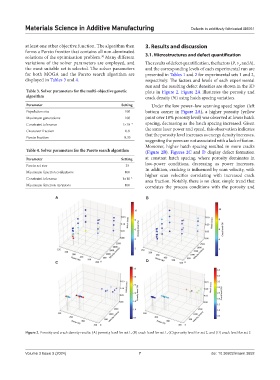
                                                               run and the resulting defect densities are shown in the 3D
            Table 3. Solver parameters for the multi‑objective genetic   plots in  Figure  2.  Figure  2A illustrates the porosity and
            algorithm                                          crack density (%) using hatch spacing variation.
            Parameter                                Setting     Under the low power–low scanning speed region (left
            Population size                           100      bottom corner in  Figure  2A), a higher porosity (yellow
            Maximum generations                       100      point over 10% porosity level) was observed at lower hatch
            Constraint tolerance                     1×10 −3   spacing, decreasing as the hatch spacing increased. Given
            Crossover fraction                        0.8      the same laser power and speed, this observation indicates
            Pareto fraction                           0.35     that the porosity level increases as energy density increases,
                                                               suggesting the pores are not associated with a lack of fusion.
                                                               Moreover, higher hatch spacing resulted in more cracks
            Table 4. Solver parameters for the Pareto search algorithm  (Figure  2B).  Figures  2C  and  D display defect formation

            Parameter                                Setting   at constant hatch spacing, where porosity dominates in
            Pareto set size                           35       low-power conditions, decreasing as power increases.
            Maximum function evaluations              100      In addition, cracking is influenced by scan velocity, with
                                                               higher scan velocities correlating with increased crack
            Constraint tolerance                     1×10 −3   area fraction. Notably, there is no clear, simple trend that
            Maximum function iterations               100      correlates  the  process  conditions  with  the  porosity  and


                         A                                     B


                         C                                     D


            Figure 2. Porosity and crack density results: (A) porosity level for set 1, (B) crack level for set 1, (C) porosity level for set 2, and (D) crack level for set 2


            Volume 3 Issue 3 (2024)                         7                              doi: 10.36922/msam.3652

