


Page 54 - MSAM-3-3
P. 54
Materials Science in Additive Manufacturing                   MEX optimization printing of rHPDE from milk jugs


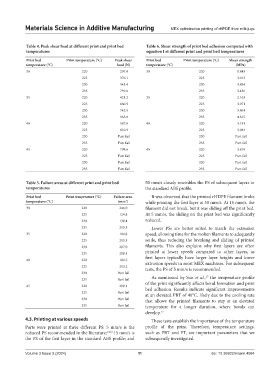
            Table 4. Peak shear load at different print and print bed   Table 6. Shear strength of print bed adhesion computed with
            temperatures                                       equation I at different print and print bed temperatures
            Print bed        Print temperature (°C)  Peak shear   Print bed    Print temperature (°C)  Shear strength
            temperature (°C)                       load (N)    temperature (°C)                      (MPa)
            30                      220             207.4      30                     220             0.843
                                    225             376.1                             225             3.013
                                    230             541.4                             230             3.884
                                    235             739.6                             235             3.436
            35                      220             421.2      35                     220             2.163
                                    225             660.9                             225             3.071
                                    230             745.5                             230             3.601
                                    235             965.0                             235             4.615
            40                      220             587.0      40                     220             3.181
                                    225             810.9                             225             3.084
                                    230            Part fail                          230            Part fail
                                    235            Part fail                          235            Part fail
            45                      220             798.6      45                     220             3.819
                                    225            Part fail                          225            Part fail
                                    230            Part fail                          230            Part fail
                                    235            Part fail                          235            Part fail


            Table 5. Failure areas at different print and print bed   50 mm/s closely resembles the PS of subsequent layers in
            temperatures                                       the standard ABS profile.

            Print bed        Print temperature (°C)  Failure area   It was observed that the printed rHDPE filament broke
            temperature (°C)                       (mm )       while printing the first layer at 50 mm/s. At 15 mm/s, the
                                                      2
            30                      220             246.0      filament did not break, but it was sliding off the print bed.
                                    225             124.8      At 5 mm/s, the sliding on the print bed was significantly
                                    230             139.4      reduced.
                                    235             215.3        Lower PSs are better suited to match the extrusion
            35                      220             194.8      speed, allowing time for the molten filaments to adequately
                                    225             215.3      settle, thus reducing the breaking and sliding of printed
                                    230             207.0      filaments. This also explains why first layers are often
                                    235             209.1      printed at lower speeds compared to other layers, as
            40                      220             184.5      first layers typically have larger layer heights and lower
                                                               extrusion speeds in most MEX machines. For subsequent
                                    225             213.2      tests, the PS of 5 mm/s is recommended.
                                    230            Part fail
                                                                                         17
                                    235            Part fail     As mentioned by Sun et al.,  the temperature profile
                                                               of the print significantly affects bond formation and print
            45                      220             209.1      bed adhesion. Results indicate significant improvements
                                    225            Part fail
                                                               at an elevated PBT of 40°C, likely due to the cooling rate
                                    230            Part fail   that allows the printed filaments to stay at an elevated
                                    235            Part fail   temperature for a longer duration, where bonds can
                                                               develop. 17
            4.3. Printing at various speeds                      These tests establish the importance of the temperature
            Parts were printed at three different PS: 5  mm/s is the   profile of the print. Therefore, temperature settings,
            reduced PS recommended in the literature; 14,16  15 mm/s is   such as PBT and PT, are important parameters that we
            the PS of the first layer in the standard ABS profile; and   subsequently investigated.


            Volume 3 Issue 3 (2024)                         11                             doi: 10.36922/msam.4084

