


Page 66 - MSAM-3-3
P. 66
Materials Science in Additive Manufacturing                              In-situ alloying of Ti41Nb by LPBF


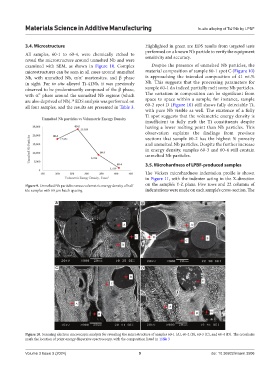
            3.4. Microstructure                                Highlighted in green are EDS results from targeted tests
                                                               performed on a known Nb particle to verify the equipment
            All samples, 60-1 to 60-4, were chemically etched to   sensitivity and accuracy.
            reveal the microstructure around unmelted Nb and were
            examined with SEM, as shown in  Figure  10. Complex   Despite the presence of unmelted Nb particles, the
            microstructures can be seen in all cases around unmelted   material composition of sample 60-1 spot C (Figure 10)
            Nb,  with  unmelted  Nb,  α/α’  martensites,  and  β  phase   is approaching the intended composition of 41 wt.%
            in sight. For  in situ alloyed Ti-41Nb, it was previously   Nb. This suggests that the processing parameters for
            observed to be predominantly composed of the β phase,   sample 60-1 do indeed partially melt some Nb particles.
            with  α” phase around the unmelted Nb regions (which   The variation in composition can be significant from
                               18
            are also deprived of Nb).  EDS analysis was performed on   space to space within a sample; for instance, sample
            all four samples, and the results are presented in Table 3.   60-2 spot D (Figure 10) still shows fully detectable Ti,
                                                               with  pure Nb  visible  as well.  The  existence  of a  fully
                                                               Ti spot suggests that the volumetric energy density is
                                                               insufficient to fully melt the Ti constituents despite
                                                               having a lower melting point than Nb particles. This
                                                               observation  explains  the  findings  from  previous
                                                               sections that sample 60-2 has the highest % porosity
                                                               and unmelted Nb particles. Despite the further increase
                                                               in energy density, samples 60-3 and 60-4 still contain
                                                               unmelted Nb particles.

                                                               3.5. Microhardness of LPBF-produced samples
                                                               The Vickers microhardness indentation profile is shown
                                                               in Figure 11, with the indenter acting in the X-direction
            Figure 9. Unmelted Nb particles versus volumetric energy density of half-  on the sample’s Y-Z plane. Five rows and 22 columns of
            tile samples with 60 μm hatch spacing              indentations were made on each sample’s cross-section. The

                         A                                   B


                         C                                   D


            Figure 10. Scanning electron microscopic analysis for revealing the microstructure of samples 60-1 (A), 60-2 (B), 60-3 (C), and 60-4 (D). The crosshairs
            mark the location of point energy dispersive spectroscopy, with the composition listed in Table 3


            Volume 3 Issue 3 (2024)                         9                              doi: 10.36922/msam.3506

