


Page 65 - MSAM-3-3
P. 65
Materials Science in Additive Manufacturing In-situ alloying of Ti41Nb by LPBF
A
B
C
D
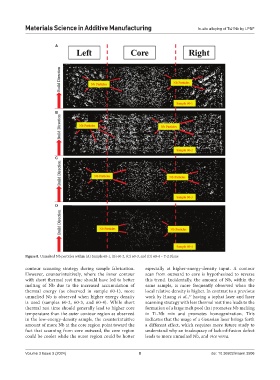
Figure 8. Unmelted Nb particles within (A) Sample 60-1, (B) 60-2, (C) 60-3, and (D) 60-4 – Y-Z Plane
contour scanning strategy during sample fabrication. especially at higher-energy-density input. A contour
However, counterintuitively, where the inner contour scan from outward to core is hypothesized to reverse
with short thermal rest time should have led to better this trend. Incidentally, the amount of Nb, within the
melting of Nb due to the increased accumulation of same sample, is more frequently observed when the
thermal energy (as observed in sample 60-1), more local relative density is higher. In contrast to a previous
unmelted Nb is observed when higher energy density work by Huang et al., having a tophat laser and laser
27
is used (samples 60-2, 60-3, and 60-4). While short scanning strategy with less thermal rest time leads to the
thermal rest time should generally lead to higher core formation of a large melt pool that promotes Nb melting
temperature than the outer contour region as observed in Ti-Nb mix and promotes homogenization. This
in the low-energy-density sample, the counterintuitive indicates that the usage of a Gaussian laser brings forth
amount of more Nb at the core region point toward the a different effect, which requires more future study to
fact that scanning from core outward, the core region understand why an inadequacy of lack-of-fusion defect
could be cooler while the outer region could be hotter leads to more unmelted Nb, and vice versa.
Volume 3 Issue 3 (2024) 8 doi: 10.36922/msam.3506

