


Page 62 - MSAM-3-3
P. 62
Materials Science in Additive Manufacturing                              In-situ alloying of Ti41Nb by LPBF


            features. Coupled with the image stitching function of the   excessive balling, damaging the recoater and resulting in
            VK-X200 confocal microscope, the entire sample surface   poor powder recoating, subsequently leading to defective
            could be mapped.                                   parts. This phenomenon, known as humping,  is caused
                                                                                                    37
              Scanning electron microscopy (SEM) with energy   by the elongated melt pool leading to Rayleigh instability.
            dispersive spectroscopy (EDS) detector by Oxford   It can result in inconsistencies in powder bed depth and,
            Instruments (aided by INCA software; UK) was also   consequently, unstable builds. Similarly, excessive balling
            utilized to reveal the composition and microstructure   was observed in samples with 40 μm hatch spacing. A set
            around the  unmelted niobium  particles.  Selected points   of samples processed with a hatch spacing of 80 and 60  μm
            of the samples were identified for elemental composition   was analyzed, with  those  with hatch  spacing  of 60  μm
            analysis through EDS.                              being selected as they presented no visible surface warping
                                                               in the as-built condition. One-half of each sample tile was
              For mechanical testing, the Future-Tech FM-300e   cut from the LPBF base plate, as shown in Figure 4. The
            Vickers Microhardness tester (Japan) was employed for   rest of the samples, while possessing interesting aspects,
            Vickers hardness tests, which featured a diamond square-  were not studied, as the focus of the paper does not lie in
            based pyramid indenter with an apex angle of 136°.   obtaining the best parameters, but rather in studying the
            The indenter was depressed onto the specimen with a   effect of thermal rest time. Therefore, the selection process
            steady load of 1 kgf, ensuring the spacing between each   was primarily narrowed down through visual inspection
            indentation and the edges of the specimen exceeded three   and is not crucial for the broader findings.
            times the diagonal length of indentation.
                                                               3.2. Sample defects and its distribution
              For tensile testing, the machined tensile coupons were
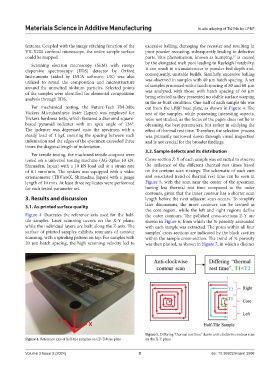
            tested on a universal testing machine (AG-Xplus 10 kN,   Cross-section Z-Y of each sample was extracted to observe
            Shimadzu, Japan) with a 10 kN load cell at a strain rate   the influence of the different thermal rest times based
            of 0.1  mm/min. The system was equipped with a video   on the contour scan strategy. The schematic of such cuts
            extensometer (TRViewX, Shimadzu, Japan) with a gauge   and associated trend of thermal rest time can be seen in
            length of 10 mm. At least three replicates were performed   Figure 5, with the scan near the center of the specimen
            for each tested parameter set.                     having less thermal rest time compared to the outer
                                                               contours, given that the inner contour has a shorter scan
            3. Results and discussion                          length before the next adjacent scan occurs. To simplify
            3.1. As-printed surface quality                    later discussions, the inner contours can be termed as
                                                               the core region, while the left and right regions define
            Figure  4 illustrates the reference axis used for the half-  the outer contours. The polished cross-sections Z-Y are
            tile samples. Laser scanning occurs on the X-Y plane,   shown in Figure 6, from which the % porosity associated
            while the individual layers are built along the Z-axis. The   with each sample was extracted. The pores within all four
            surface of printed samples exhibits remnants of contour   samples’ cross-sections are indicated by the black cavities
            scanning, with a spiraling pattern on top. For samples with   within the sample cross-section. The trend of % porosity
            20  μm hatch spacing, the high scanning velocity led  to   was then plotted, as shown in Figure 7, in which a distinct


                                                               Figure 5. Differing “thermal rest time” due to anti-clockwise contour scan
            Figure 4. Reference axis of half-tile samples on CP-Ti base plate  on the X-Y plane


            Volume 3 Issue 3 (2024)                         5                              doi: 10.36922/msam.3506

