


Page 63 - MSAM-3-3
P. 63
Materials Science in Additive Manufacturing In-situ alloying of Ti41Nb by LPBF
A
B
C
D
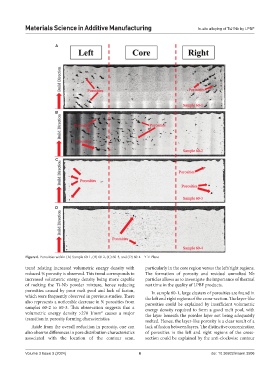
Figure 6. Porosities within (A) Sample 60-1, (B) 60-2, (C) 60-3, and (D) 60-4 – Y-Z Plane
trend relating increased volumetric energy density with particularly in the core region versus the left/right regions.
reduced % porosity is observed. This trend corresponds to The formation of porosity and residual unmelted Nb
increased volumetric energy density being more capable particles allows us to investigate the importance of thermal
of melting the Ti-Nb powder mixture, hence reducing rest time in the quality of LPBF products.
porosities caused by poor melt pool and lack of fusion, In sample 60-1, large clusters of porosities are found in
which were frequently observed in previous studies. There the left and right regions of the cross-section. The layer-like
also represents a noticeable decrease in % porosities from porosities could be explained by insufficient volumetric
samples 60-2 to 60-3. This observation suggests that a energy density required to form a good melt pool, with
volumetric energy density >270 J/mm causes a major the layer beneath the powder layer not being adequately
3
transition in porosity forming characteristics. melted. Hence, the layer-like porosity is a clear result of a
Aside from the overall reduction in porosity, one can lack of fusion between layers. The distinctive concentration
also observe differences in pore distribution characteristics of porosities in the left and right regions of the cross-
associated with the location of the contour scan, section could be explained by the anti-clockwise contour
Volume 3 Issue 3 (2024) 6 doi: 10.36922/msam.3506

