


Page 60 - MSAM-3-3
P. 60
Materials Science in Additive Manufacturing                              In-situ alloying of Ti41Nb by LPBF


            absorbs most of the load, thereby reducing stress on the   2.2. Fabrication of tiles with contour scanning
            surrounding bone, which can lead to surrounding bone   strategy
            resorption and  implant loosening).  To contextualize  the   Tabulated in  Table  1 are the process parameters and
            alloy  composition  selected  for  this  study,  achieving  a   resulting volumetric energy density for each of the
            low  Young’s  modulus  coupled  with  adequate  strength  is   sample tiles. The processing parameters were selected
            crucial, typically achieved by retaining the full  β-phase   based on the maximum energy density of 410 J/mm³ used
            with minimal alloying additions.  It is widely recognized   in a study on TiNb by Huang et al.,  which served as the
                                      34
                                                                                            18
            that two minima in Young’s modulus are observable,   upper limit. The laser power and powder layer thickness
            primarily at approximately 42 wt.% Nb, where the material   were maintained at 390 W and 0.05  mm, respectively.
            consists predominantly of the  β-phase and is attained   The hatch spacing was reduced from the leftmost column
            through quenching.  Extending this understanding to   to the right. To maintain the energy density across each
                            35
            LPBF, Wang et al. investigated in situ alloying of Ti-xNb   row, the laser scanning speed for each sample tile was
            alloys (where x  = 0, 15, 25, 45 at.%) using LPBF.  Their   calculated accordingly. The samples produced in this step
                                                    26
            findings highlighted that the composition with 25 at.%   would be used for microstructural and microhardness
            Nb (approximately 39 wt%) exhibited the lowest Young’s   analysis. To study the effect of thermal rest time, the anti-
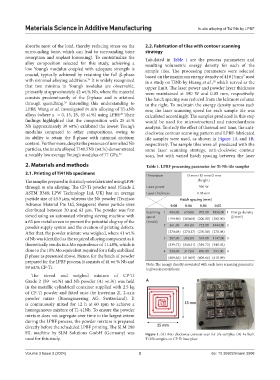
            modulus compared to other compositions, owing to   clockwise contour scanning pattern and LPBF-fabricated
            its ability to retain the  β-phase with minimal niobium   tile samples were used, as shown in Figure 1A and 1B,
            content. Furthermore, despite the presence of unmelted Nb   respectively. The sample tiles were all produced with the
            particles, the in situ alloyed Ti40.5Nb (wt.%) demonstrated   same laser scanning strategy, anti-clockwise contour
            a notably low average Young’s modulus of 77 GPa. 36  scan, but with varied hatch spacing between the laser

            2. Materials and methods                           Table 1. LPBF processing parameter for Ti‑Nb tile samples
            2.1. Printing of Ti41Nb specimens                  Dimension        15 mm×15 mm×5 mm
            The samples prepared in this study were fabricated using LPBF            (height)
            through in situ alloying. The CP-Ti powder used (Grade 2   Laser power    390 W
            ASTM  B348; LPW  Technology  Ltd,  UK)  has an  average   Layer thickness  0.05 mm
            particle size of 43.5 μm, whereas the Nb powder (Tecnisco         Hatch spacing (mm)
            Advance Material Pte Ltd, Singapore) shows particle sizes     0.08  0.06  0.04  0.02
            distributed between 20 and 63 μm. The powder was first   Scanning  1  488.00  650.00  975.00  1950.00 1 Energy density
            sieved using an automated vibrating sieving machine with   speed   (199.80) (200.00) (200.00) (200.00)  (J/mm )
                                                                                                       3
            a 63 μm metal screen to prevent the potential clog-up of the   (mm/s)
            powder supply system and the creation of printing defects.   2  361.00  481.00  722.00  1444.00 2
            After that, the powder mixture was weighed, where 41 wt.%    (270.08) (270.27) (270.08) (270.08)
            of Nb was identified as the required alloying component as it   3  287.00  382.00  574.00  1147.00 3
            theoretically results in a Mo equivalence of 11.48%, which is   (339.72) (340.31) (339.72) (340.02)
            close to the 10% Mo equivalent required for a fully stabilized   4  238.00  317.00  476.00  951.00 4
            β phase as presented above. Hence, for the batch of powder   (409.66) (410.09) (409.66) (410.09)
            prepared for the LPBF process, it consists of 41 wt.% Nb and   Note: The energy density associated with each laser scanning parameter
            59 wt.% CP-Ti.                                     is given in parenthesis.
              The  sieved  and weighed mixture  of CP-Ti
            Grade 2 (59  wt.%) and Nb powder (41 wt.%) was held   A                  B
            in the metallic cylindrical container supplied with 2.5 kg
            of CP-Ti powder and fitted onto the Inversina 2L 2-axis
            powder mixer (Bioengineering AG, Switzerland). It
            is continuously mixed for 12  h at 60  rpm to achieve a
            homogeneous mixture of Ti-41Nb. To ensure the powder
            mixture does not segregate over time to the largest extent
            during the LPBF process, the powder mixture is prepared
            directly before the scheduled LPBF printing. The SLM 280
            HL machine by SLM Solutions  GmbH (Germany) was    Figure 1. (A) Anti-clockwise contour scan for tile samples. (B) As-built
            used for this study.                               Ti-Nb samples on CP-Ti base plate


            Volume 3 Issue 3 (2024)                         3                              doi: 10.36922/msam.3506

