


Page 64 - MSAM-3-3
P. 64
Materials Science in Additive Manufacturing                              In-situ alloying of Ti41Nb by LPBF


            scan, which results in the core region being exposed to the   energy density of 340  J/mm³ and 410  J/mm³, exhibit
            laser source at shorter intervals (Figure 5). The core region   the  characteristic  of  a  lack-of-fusion  defect  and  keyhole
            is composed of shorter scanning vectors, which is opposed   porosity. This is surprising, given that the volumetric energy
            to the one on the outer contour, and with short scanning   density is relatively high, with previous literature showing
            vectors, constant scanning velocity meant that the adjacent   near full density obtainable with similar energy density,
            laser scan will occur in a lesser time near the core region   which would have formed mainly keyhole porosity. The
            as opposed to the outer region, hence leading to more   usage of high energy density leads to excessive vaporization
            thermal accumulation, given that there are less time for the   and high vapor pressure, pushing the melt and create deep
            heat to dissipate before subsequent scan. Thus, with less   drill in the melt pool. This deep cavity allows for increased
            “thermal rest time,” the core region exhibits better titanium   laser absorption and exacerbates the drilling effect. When
            melting characteristics and fewer porosities.      the melt pool collapses, some gas is trapped before it can
              In sample 60-2, large porosities are found in the   escape, thereby leading to keyhole pores. This suggests that
            left and core regions of the cross-section, while small   there are additional melt pool dynamics that need to be
            porosities are found in the right region, indicating that   considered when contour scan is used, and these dynamics
            built instability could occur despite theoretically similar   have not yet been studied.
            scanning strategies. The layer-like porosities form in   3.3. Distribution of unmelted niobium particles
            the same manner as explained previously, constituting
            a lack-of-fusion defect. However, one can still observe   Sample imaging and computerized particle tabulations
            that the pores in the core region are smaller and less   are performed on the polished Y-Z plane of the half-tile
            continuous compared to the left region, owing to thermal   samples. After image processing, unmelted Nb particles
            accumulation promoting melting with lesser thermal rest   (in white) were clearly visible across the samples’ cross-
            time. The highest % porosity associated with sample 60-2   section, as seen in Figure 8. The percentage of unmelted
            aligns well with the observation, as shown in  Figure  6.   Nb associated with each sample was calculated and plotted,
            This combined observation suggests that the processing   as shown in Figure 9.
            parameters for sample 60-2 result in the poorest as-built   In sample 60-2, there is a significantly higher count of
            condition.                                         unmelted Nb particles. This observation is explained by
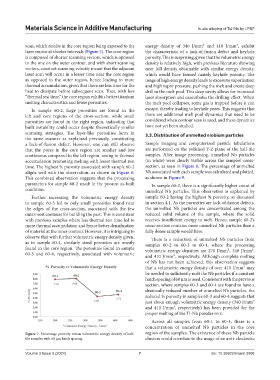
              Further increasing the volumetric energy density   sample 60-2 having the highest % porosity, as discussed
            to sample 60-3 led to only small porosities found near   in section 4.1. As the porosities are lack-of-fusion defects,
            the edges of the cross-section, associated with the few   the unmelted Nb particles are concentrated among the
            outermost contours for building the part. This is consistent   reduced solid  volume  of  the  sample,  where  the  solid
            with previous samples where less thermal rest time led to   receives insufficient energy to melt. Hence, sample 60-2’s
            more thermal accumulation and hence better densification   cross-section contains more unmelted Nb particles than a
            of material at the inner contour. However, it is intriguing to   fully dense sample would have.
            observe that with further volumetric energy density given,   There is a reduction of unmelted Nb particles from
            as in sample 60-4, similarly sized porosities are mostly   samples  60-2  to  60-3  to  60-4, where  the processing
            found in the core region. The porosities found in sample   volumetric energy densities are 270  J/mm³,  340  J/mm³,
            60-3 and 60-4, respectively, associated with volumetric   and 410 J/mm³, respectively. Although complete melting
                                                               of  Nb has  not  been  achieved,  this  observation suggests
                                                               that a volumetric energy density of over 410 J/mm³ may
                                                               be needed to sufficiently melt the Nb particles if a constant
                                                               hatch spacing of 60 μm is used. Consistent with the previous
                                                               section, where samples 60-3 and 60-4 are found to have a
                                                               drastically reduced number of unmelted Nb particles, the
                                                               reduced % porosity in samples 60-3 and 60-4 suggests that
                                                               just about enough volumetric energy density (340 J/mm³
                                                               and 410  J/mm³, respectively) has been provided for the
                                                               proper melting of the Ti-Nb powder mix.

                                                                 Across all samples from 60-1 to 60-4, there is a
                                                               concentration of unmelted Nb particles in the core
            Figure 7. Percentage porosity versus volumetric energy density of half-  region of the samples. The existence of these Nb particle
            tile samples with 60 μm hatch spacing              clusters could correlate to the usage of an anti-clockwise


            Volume 3 Issue 3 (2024)                         7                              doi: 10.36922/msam.3506

