


Page 161 - MSAM-4-3
P. 161
Materials Science in Additive Manufacturing                 L-PBF Ti-10Ta-2Nb-2Zr: Microstructure and Strength


            features of the gyroid lattice. The gyroid represents a triply   in space and eliminates sharp angles or abrupt cross-
            periodic minimal surface with constant mean curvature,   sectional changes characteristic of other topologies. This
            which provides the most uniform material distribution   leads  to  more  stable  heat transfer  conditions  during  the
                                                               L-PBF process, minimization of stress concentrators, and
            Table 5. Compression mechanical properties of lattice and   consequently, enhanced reproducibility of mechanical
            solid structures                                   properties among different specimens.
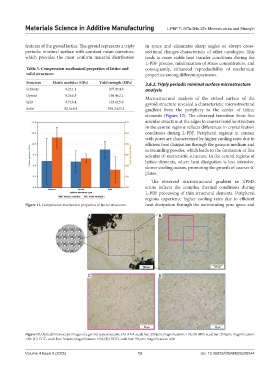
            Structure  Elastic modulus (GPa)  Yield strength (MPa)  3.6.2. Triply periodic minimal surface microstructure
            Schwarz          9.2±1.1           207.9±4.8       analysis
            Gyroid           9.2±0.5           198.4±2.1       Microstructural analysis of the etched surface of the
            Split            9.7±0.4           193.6±5.9       gyroid structure revealed a characteristic microstructural
            Solid           52.2±8.4           539.3±23.3      gradient from the periphery to the center of lattice
                                                               elements (Figure  12). The observed transition from fine
                                                               acicular structure at the edges to coarser lamellar structure
                                                               in the central regions reflects differences in crystallization
                                                               conditions  during  L-PBF.  Peripheral  regions in  contact
                                                               with pores are characterized by higher cooling rates due to
                                                               efficient heat dissipation through the gaseous medium and
                                                               surrounding powder, which leads to the formation of fine
                                                               acicular α’-martensitic structure. In the central regions of
                                                               lattice elements, where heat dissipation is less intensive,
                                                               slower cooling occurs, promoting the growth of coarser α’
                                                               plates.
                                                                 The observed microstructural gradient in TPMS
                                                               struts reflects the complex thermal conditions during
                                                               L-PBF processing of thin structural elements. Peripheral
                                                               regions experience higher cooling rates due to efficient
            Figure 11. Compression mechanical properties of lattice structures  heat dissipation through the surrounding pore space and
                                       A                             B


                                      C                              D


            Figure 12. Optical microscope images of a gyroid-type structure. (A) AAA, scale bar: 250 μm; magnification: ×10; (B) BBB, scale bar: 250 μm; magnification:
            ×20; (C) CCC, scale bar: 50 μm; magnification: ×50; (D) DDD, scale bar: 50 μm; magnification: ×50


            Volume 4 Issue 3 (2025)                         13                        doi: 10.36922/MSAM025220044

