


Page 30 - MSAM-4-3
P. 30
Materials Science in Additive Manufacturing Numerical simulation of plasma WAAM for Ti-6Al-4V
2.1.1. Governing equations
Finite element (FE) simulations are conducted to compute
transient temperature fields, which subsequently serve as
input for a thermal elasticplastic mechanical analysis to
evaluate deformations and residual stresses of large-scale
Ti6Al4V WAAM components. Welding simulations are
typically performed as sequential coupled analyses, where
the transient temperature field is first computed, followed
by structural mechanics calculations. Consequently, the
AM process is divided into two primary stages: A heat
transfer analysis and a mechanical analysis. These stages
are computed separately in a one-way thermo-mechanical
coupling approach, meaning that the transient thermal
distributions recorded during material deposition are
stored at specific time steps and then used as input data for
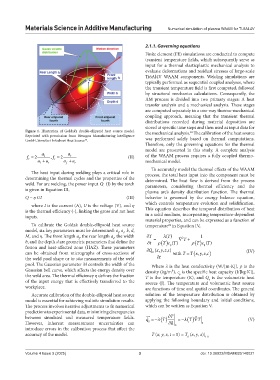
Figure 1. Illustration of Goldak’s double-ellipsoid heat source model. the mechanical analysis. The calibration of the heat source
23
Reprinted with permission from Hexagon Manufacturing Intelligence
GmbH, Simufact Infosheet Heat Source . was performed solely based on thermal computations.
20
Therefore, only the governing equations for the thermal
model are presented in this study. A complete analysis
a a
f = 2 a + f a r , f = 2 a + r a r (II) of the WAAM process requires a fully coupled thermo-
f
r
mechanical model.
f
f
To accurately model the thermal effects of the WAAM
The heat input during welding plays a critical role in process, the total heat input into the component must be
determining the thermal cycles and the properties of the determined. The heat flow is derived from the process
weld. For arc welding, the power input Q (J) by the torch parameters, considering thermal efficiency and the
is given in Equation III, plasma arc’s density distribution function. The thermal
Q = η UI (III) behavior is governed by the energy balance equation,
where I is the current (A), U is the voltage (V), and η which controls temperature evolution and solidification.
is the thermal efficiency (-), linking the gross and net heat This equation describes the temporal distribution of heat
inputs. in a solid medium, incorporating temperature-dependent
material properties, and can be expressed as a function of
To calibrate the Goldak double-ellipsoid heat source temperature in Equation IV,
24
model, six key parameters must be determined: a, a , b, d,
r
f
T
M, and η. The front length a, the rear length a , the width ∂T λ() 2 1
r
f
b, and the depth d are geometric parameters that define the ∂t = ρ Tc T() ∇ T + ρ Tc T()
() p
fusion and heat-affected zone (HAZ). These parameters ∂Qx yz t) () p
(, ,,
= (
can be obtained from micrographs of cross-sections of V with TT xy , ,, ,zt) (IV)
the weld pool shape or in situ measurements of the weld ∂t
pool. The Gaussian parameter M controls the width of the Where λ is the heat conductivity (W/[m⋅K]), ρ is the
Gaussian bell curve, which affects the energy density over density (kg/m³), c is the specific heat capacity (J/[kg⋅K]),
p
the weld area. The thermal efficiency η defines the fraction T is the temperature (K), and Q is the volumetric heat
v
of the input energy that is effectively transferred to the source (J). The temperature and volumetric heat source
workpiece. are functions of time and spatial coordinates. The general
Accurate calibration of the double-ellipsoid heat source solution of the temperature distribution is obtained by
model is essential for achieving realistic simulation results. applying the following boundary and initial conditions,
The process involves iterative adjustments to fit numerical which can be written as Equation V.
predictions to experimental data, minimizing discrepancies
between simulated and measured temperature fields. λ T ∂ T =−λ T ()∇ T (V)
q =− ()
However, inherent measurement uncertainties can S ∂ n S S
introduce errors in the calibration process that affect the
accuracy of the model. T (x, y, z, t = 0) = T (x, y, z)|
0 t=0
Volume 4 Issue 3 (2025) 3 doi: 10.36922/MSAM025140021

