


Page 21 - OR-1-1
P. 21
A                         B                        C


                           D                       E                          F


                           G                                  H


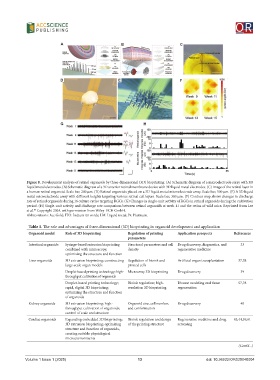
            Figure 8. Development analysis of retinal organoids by three-dimensional (3D) bioprinting. (A) Schematic diagram of a microelectrode array with 3D
            liquid metal electrodes. (B) Schematic diagram of a 3D anterior retinal membrane device with 3D liquid metal electrodes. (C) Image of the retinal layer in
            a human retinal organoid. Scale bar, 200 μm. (D) Retinal organoids placed on a 3D liquid metal microelectrode array. Scale bar, 500 μm. (E) A 3D liquid
            metal microelectrode array with different heights targeting various retinal cell layers. Scale bar, 300 μm. (F) Contour map shows changes in discharge
            rate of retinal organoids during 16 culture cycles targeting RGCs. (G) Changes in single-unit activity of RGCs in retinal organoids during the cultivation
            period. (H) Single-unit activity and discharge rate comparison between retinal organoids at week 11 and the retina of wild mice. Reprinted from Lee
            et al.  Copyright 2024, with permission from Wiley-VCH GmbH.
               87
            Abbreviations: Au: Gold; ITO: Indium tin oxide; LM: Liquid metal; Pt: Platinum.

             Table 1. The role and advantages of three-dimensional (3D) bioprinting in organoid development and application
             Organoid model  Role of 3D bioprinting    Regulation of printing   Application prospects  References
                                                       parameters
             Intestinal organoids  Syringe-based extrusion bioprinting   Structural parameters and cell   Drug discovery, diagnostics, and   33
                             combined with microscopy;   density             regenerative medicine
                             optimizing the structure and function
             Liver organoids  3D extrusion bioprinting; constructing  Regulation of bioink and   Artificial organ transplantation  37,38
                             large-scale organ models  printed cells
                             Droplet-based printing technology; high-  Microarray 3D bioprinting  Drug discovery  39
                             throughput cultivation of organoids
                             Droplet-based printing technology;   Bioink regulation; high-  Disease modeling and tissue   57,78
                             rapid, digital 3D bioprinting;   resolution 3D bioprinting  regeneration
                             optimizing the structure and function
                             of organoids
             Kidney organoids  3D extrusion bioprinting; high-  Organoid size, cell number,   Drug discovery  40
                             throughput cultivation of organoids;   and conformation
                             control of scale and structure
             Cardiac organoids  Expanding embedded 3D bioprinting;   Bioink regulation and design   Regenerative medicine and drug   43,44,59,61
                             3D extrusion bioprinting; optimizing   of the printing structure  screening
                             structure and function of organoids,
                             creating suitable physiological
                             microenvironments
                                                                                                      (Cont’d...)


            Volume 1 Issue 1 (2025)                         13                           doi: 10.36922/OR025040004

