


Page 20 - OR-1-1
P. 20
A                      B


                           C


                           D                     E


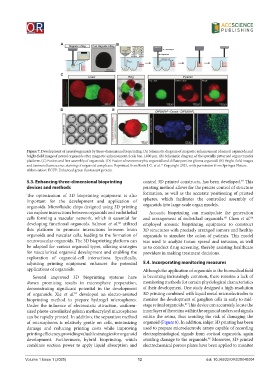
            Figure 7. Development of neural organoids by three-dimensional bioprinting. (A) Schematic diagram of magnetic enhancement of neural organoids and
            bright-field image of neural organoids after magnetic enhancement. Scale bar, 1,000 μm. (B) Schematic diagram of the spatially patterned organ transfer
            platform. (C) Fusion and free assembly of organoids. (D) Fusion of neuromorphic organoid and diffuse pontine glioma organoid. (E) Bright-field images
            and immunofluorescence staining of organoid complexes. Reprinted from Roth J. G. et al.  Copyright 2021, with permission from Springer Nature.
                                                                     71
            Abbreviation: EGFP: Enhanced green fluorescent protein.

            5.3. Enhancing three-dimensional bioprinting      control 3D printed constructs, has been developed.  This
                                                                                                        84
            devices and methods                               printing method allows for the precise control of structure
            The  optimization  of  3D  bioprinting  equipment  is  also   formation, as well as the accurate positioning of printed
            important for  the  development and  application of   spheres, which facilitates the controlled assembly of
            organoids. Microfluidic chips designed using 3D printing   organoids into large-scale organ models.
            can explore interactions between organoids and endothelial   Acoustic  bioprinting  can  manipulate  the  generation
            cells forming a vascular network, which is essential for   and arrangement of individual organoids.  Chen  et al.
                                                                                                85
                                                                                                            86
            developing functional organoids. Salmon  et al.  utilized   employed acoustic bioprinting equipment to construct
                                                   82
            this platform to promote interactions between brain   3D structures with precisely arranged tumors and healthy
            organoids and vascular cells, leading to the formation of   organoids to simulate the colon of patients. This model
            neurovascular organoids. The 3D bioprinting platform can   was used to analyze tumor spread and invasion, as well
            be adapted for various organoid types, offering strategies   as to conduct drug screening, thereby assisting healthcare
            for vascularized organoid development and enabling the   providers in making treatment decisions.
            exploration of organoid-cell interactions. Specifically,
            adjusting printing equipment enhances the potential   5.4. Incorporating monitoring measures
            applications of organoids.                        Although the application of organoids in the biomedical field
               Several improved 3D bioprinting systems have   is becoming increasingly common, there remains a lack of
            shown promising results in microsphere preparation,   monitoring methods for certain physiological characteristics
            demonstrating significant potential in the development   of their development. One study designed a high-resolution
                                 83
            of organoids. Xie  et al.  developed an electro-assisted   3D printing combined with liquid metal microelectrodes to
            bioprinting method to prepare hydrogel microspheres.   monitor the development of ganglion cells in early to mid-
                                                                                87
            Under the influence of electrostatic attraction, uniform-  stage retinal organoids.  This device can accurately locate the
            sized photo-crosslinked gelatin methacryloyl microspheres   inner layer of the retina within the organoid and record signals
            can be rapidly printed. In addition, the separation method   within the retina, thus avoiding the risk of damaging the
            of microspheres is relatively gentle on cells, minimizing   organoid (Figure 8). In addition, inkjet 3D printing has been
            damage  and reducing printing  costs  while  improving   used to prepare microelectrode arrays capable of recording
            printing efficiency, providing valuable strategies for organoid   electrophysiological  signals  from  cortical  organoids,  again
            development. Furthermore, hybrid  bioprinting, which   avoiding damage to the organoids.  Moreover, 3D-printed
                                                                                         88
            combines suction power to apply liquid absorption and   electrochemical porous plates have been applied to monitor


            Volume 1 Issue 1 (2025)                         12                           doi: 10.36922/OR025040004

