


Page 22 - OR-1-1
P. 22
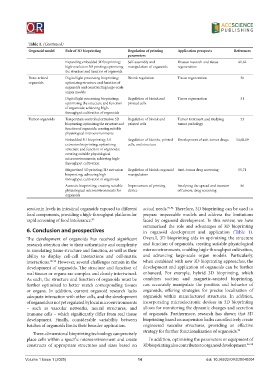
Table 1. (Continued)
             Organoid model  Role of 3D bioprinting    Regulation of printing   Application prospects  References
                                                       parameters
                             Expanding embedded 3D bioprinting;   Self-assembly and   Disease research and tissue   61,62
                             high-resolution 3D printing; optimizing  manipulation of organoids  regeneration
                             the structure and function of organoids
             Bone-related    Digital light processing bioprinting;   Bioink regulation  Tissue regeneration  50
             organoids       optimizing structure and function of
                             organoids and constructing large-scale
                             organ models
                             Digital light processing bioprinting;   Regulation of bioink and   Tissue regeneration  51
                             optimizing the structure and function   printed cells
                             of organoids; achieving high-
                             throughput cultivation of organoids
             Tumor organoids  Temperature-controlled extrusion 3D   Regulation of bioink and   Tumor treatment and studying   53
                             bioprinting; optimizing the structure and  printed cells  tumor pathology
                             function of organoids; creating suitable
                             physiological microenvironments
                             Embedded 3D bioprinting; 3D   Regulation of bioinks, printed   Development of anti-tumor drugs  54,68,69
                             extrusion bioprinting; optimizing   cells, and structure
                             structure and function of organoids;
                             creating suitable physiological
                             microenvironments; achieving high-
                             throughput cultivation
                             Magnetized 3D printing; 3D extrusion   Regulation of bioink; organoid  Anti-tumor drug screening  55,71
                             bioprinting; achieving high-  manipulation
                             throughput cultivation of organoids
                             Acoustic bioprinting; creating suitable   Improvement of printing   Analyzing the spread and invasion   86
                             physiological microenvironments for   device    of tumors; drug screening
                             organoids


            serotonin levels in intestinal organoids exposed to different   actual needs. 93,94  Therefore, 3D bioprinting can be used to
            food components, providing a high-throughput platform for   prepare impeccable models and address the limitations
            rapid screening of food intolerance. 89           faced  by  organoid  development.  In  this  review,  we  have
                                                              summarized the role and advantages of 3D bioprinting
            6. Conclusion and prospectives                    in organoid development and application (Table 1).

            The development of organoids has received significant   Overall, 3D bioprinting aids in optimizing the structure
            research attention due to their authenticity and complexity   and function of organoids, creating suitable physiological
            in simulating tissue structure and function, as well as their   microenvironments, enabling high-throughput cultivation,
            ability to display cell-cell interactions and cell-matrix   and advancing large-scale organ models. Particularly,
            interactions. 90-92  However, several challenges remain in the   when combined with new 3D bioprinting approaches, the
            development of organoids. The structure and function of   development and application of organoids can be further
            real tissues or organs are complex and closely intertwined.   enhanced. For example, hybrid 3D bioprinting, which
            As such, the structure and function of organoids must be   combines suction and magnetic-assisted bioprinting,
            further optimized to better match corresponding tissues   can  accurately  manipulate  the  position  and  behavior  of
            or organs. In addition, current organoid research lacks   organoids, offering strategies for precise localization of
            adequate interaction with other cells, and the development   organoids within manufactured structures. In addition,
            of organoids is not yet regulated by local microenvironments   incorporating microelectronic devices in 3D bioprinting
            –  such  as  vascular  networks,  neural  structures,  and   allows for monitoring the dynamic changes and secretion
            immune cells – which significantly differ from real tissue   of  organoids.  Furthermore,  research  has  shown  that  3D
            development. Finally, considerable variability between   bioprinting based on suspension baths can effectively create
            batches of organoids limits their broader application.  engineered  vascular  structures,  providing  an  effective
               Three-dimensional bioprinting technology can precisely   strategy for further functionalization of organoids. 95
            place cells within a specific microenvironment and create   In addition, optimizing the parameters or equipment of
            constructs of appropriate structures and sizes based on   3D bioprinting also contributes to organoid development. 96-98


            Volume 1 Issue 1 (2025)                         14                           doi: 10.36922/OR025040004

