


Page 52 - OR-1-2
P. 52
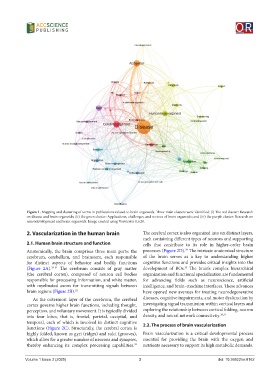
Figure 1. Mapping and clustering of terms in publications related to brain organoids. Three main clusters were identified: (i) The red cluster: Research
            on disease and brain organoids; (ii) the green cluster: Applications, challenges, and reviews of brain organoids; and (iii) the purple cluster: Research on
            neurodevelopment and brain organoids. Image created using Vosviewer 1.6.20.

            2. Vascularization in the human brain             The cerebral cortex is also organized into six distinct layers,
                                                              each containing different types of neurons and supporting
            2.1. Human brain structure and function           cells that contribute to its role in higher-order brain
                                                                                34
            Anatomically, the brain comprises three main parts: the   processes (Figure 2D).  The intricate anatomical structure
            cerebrum,  cerebellum,  and  brainstem,  each  responsible   of the brain serves as a key to understanding higher
            for distinct aspects of behavior and bodily functions   cognitive functions and provides critical insights into the
                                                                                35
            (Figure  2A). 29-31  The cerebrum consists of gray matter   development of BOs.  The brain’s complex  hierarchical
            (the cerebral cortex), composed of neuron cell bodies   organization and functional specialization are fundamental
            responsible for processing information, and white matter,   for advancing fields such as neuroscience, artificial
            with myelinated axons for transmitting signals between   intelligence, and brain–machine interfaces. These advances
            brain regions (Figure 2B). 32                     have opened new avenues for treating neurodegenerative

               As the outermost layer of the cerebrum, the cerebral   diseases, cognitive impairments, and motor dysfunction by
            cortex governs higher brain functions, including thought,   investigating signal transmission within cortical layers and
            perception, and voluntary movement. It is typically divided   exploring the relationship between cortical folding, neuron
            into  four  lobes,  that is,  frontal, parietal,  occipital, and   density, and neural network connectivity. 36,37
            temporal, each of which is involved in distinct cognitive   2.2. The process of brain vascularization
            functions (Figure 2C). Structurally, the cerebral cortex is
            highly folded, known as gyri (ridges) and sulci (grooves),   Brain vascularization is a critical developmental process
            which allow for a greater number of neurons and synapses,   essential for providing the brain with the oxygen and
            thereby  enhancing  its  complex  processing capabilities.    nutrients necessary to support its high metabolic demands.
                                                          33

            Volume 1 Issue 2 (2025)                         3                                 doi: 10.36922/or.8162

