


Page 54 - OR-1-2
P. 54
A


                           B


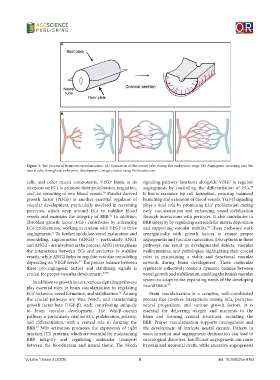
            Figure 3. The process of brain neovascularization. (A) Formation of the neural tube during the embryonic stage. (B) Angiogenic sprouting into the
            neural tube throughout embryonic development. Image created using BioRender.com.

            cells, and other neural components, VEGF binds to its   signaling pathway functions alongside VEGF  to  regulate
            receptors on ECs to promote their proliferation, migration,   angiogenesis by controlling the differentiation of ECs.
                                                                                                            58
                                             50
            and the sprouting of new blood vessels.  Platelet-derived   It limits excessive tip cell formation, ensuring balanced
            growth factor (PDGF) is another essential regulator of   branching and extension of blood vessels. TGF-β signaling
            vascular development, particularly involved in recruiting   plays a dual role by promoting ECs’ proliferation during
            pericytes, which wrap around ECs to stabilize blood   early  vascularization  and  enhancing  vessel  stabilization
            vessels and maintain the integrity of BBB.  In addition,   through interactions with pericytes. It also contributes to
                                                51
            fibroblast growth factor (FGF) contributes by enhancing   BBB integrity by regulating extracellular matrix deposition
            ECs’ proliferation, working in tandem with VEGF to drive   and  supporting  vascular  stability.   These  pathways  work
                                                                                         59
            angiogenesis.  To further modulate vessel maturation and   synergistically with growth factors to ensure proper
                       52
            remodeling, angiopoietins (ANGs) – particularly ANG1   angiogenesis and vascular maturation. Disruptions in these
            and ANG2 – are involved in the process. ANG1 strengthens   pathways can result in developmental defects, vascular
            the interactions between ECs and pericytes to stabilize   malformations, and pathologies, highlighting their crucial
            vessels, while ANG2 helps to regulate vascular remodeling   roles in maintaining a stable and functional vascular
            depending on VEGF levels.  The precise balance between   network during brain development. These molecular
                                   53
            these pro-angiogenic factors and stabilizing signals is   regulators collectively create a dynamic balance between
            crucial for proper vascular development. 54,55    vessel growth and stabilization, enabling the brain’s vascular
               In addition to growth factors, various signaling pathways   system to adapt to the expanding needs of the developing
                                                                        60
            play essential roles in brain vascularization by regulating   neural tissue.
            ECs’ behavior, vessel formation, and stabilization.  Among   Brain vascularization is a complex, well-coordinated
                                                    56
            the crucial pathways are Wnt, Notch, and transforming   process that involves interactions among ECs, pericytes,
            growth factor-beta (TGF-β), each contributing uniquely   neural  progenitors,  and  various  growth  factors.  It  is
            to brain vascular development. The Wnt/β-catenin   essential for delivering oxygen and nutrients to the
            pathway is particularly vital for ECs’ proliferation, polarity,   brain and  forming  critical structures,  including the
            and differentiation, with a central role in forming the   BBB. Proper vascularization supports neurogenesis and
            BBB.  Wnt activation promotes the expression of tight   the development of intricate neural circuits. Defects in
                57
            junction (TJ) proteins, which are essential for maintaining   vascularization and angiogenesis dysfunction can lead to
            BBB integrity and regulating molecular transport   neurological disorders. Insufficient angiogenesis can cause
            between the bloodstream and neural tissue. The Notch   hypoxia and neuronal death, while excessive angiogenesis


            Volume 1 Issue 2 (2025)                         5                                 doi: 10.36922/or.8162

