


Page 59 - OR-1-2
P. 59
Batch-to-batch inconsistencies can arise due to differences in   integrity. It drives sprouting angiogenesis by activating
            cell sourcing, culture conditions, and the timing of co-culture   the VEGF–VEGF receptor (VEGFR) signaling pathway,
            integration. Standardizing protocols and employing automated   which initiates the Delta-like ligand 4–Notch cascade.
            systems may enhance reproducibility and scalability.  This cascade regulates ECs’ differentiation, ensuring the
                                                              proper roles of tip and stalk cells, which are essential for
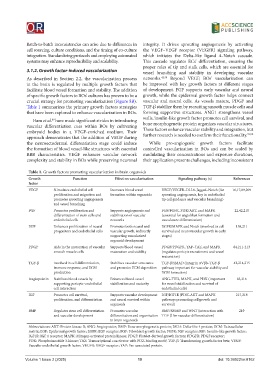
            3.1.2. Growth factor-induced vascularization      vessel  branching  and stability in  developing  vascular
            As described in Section 2.2, the vascularization process   networks. 42,90  Beyond VEGF, BOs’ vascularization can
            in the brain is regulated by multiple growth factors that   be improved with key growth factors at different stages
            facilitate blood vessel formation and stability. The addition   of  development.  FGF  supports  early  vascular  and  neural
            of specific growth factors to BOs’ cultures has proven to be a   growth, while the epidermal growth factor helps connect
            crucial strategy for promoting vascularization (Figure 5B).   vascular and neural cells. As vessels mature, PDGF and
            Table 1 summarizes the primary growth factors strategies   TGF-β stabilize them by recruiting smooth muscle cells and
            that have been explored to enhance vascularization in BOs.  forming supportive structures. ANG1 strengthens vessel
                                                              walls, insulin-like growth factor promotes cell survival, and
                       89
               Ham et al.  have made significant strides in introducing
            vascular differentiation  cues within BOs  by cultivating   bone morphogenetic protein organizes vascular structures.
            embryoid bodies in a VEGF-enriched medium. Their   These factors enhance vascular stability and integration, but
                                                                                                          91,92
            approach demonstrates that the addition of VEGF during   further research is needed to confirm their functionality.
            the neuroectodermal differentiation stage could induce   While pro-angiogenic growth factors facilitate
            the formation of blood vessel-like structures with essential   controlled vascularization in BOs and can be scaled by
            BBB  characteristics.  VEGF  enhances  vascular  network   modulating their concentrations and exposure durations,
            complexity and stability in BOs while preserving neuronal   their application presents challenges, including inconsistent

             Table 1. Growth factors promoting vascularization in brain organoids
             Growth             Function          Effect on vascularization  Signaling pathway (s)  References
             factor
             VEGF       Stimulates endothelial cell   Increases blood vessel   VEGF/VEGFR–DLL4–Jagged–Notch (for   16,17,89,209
                        proliferation and migration and   formation within organoids  sprouting angiogenesis, key in endothelial
                        promotes sprouting angiogenesis               tip cell guidance and vascular branching)
                        and vessel branching
             FGF        Promotes proliferation and   Supports angiogenesis and   FGF/FGFR, PI3K/AKT, and MAPK   22,42,210
                        differentiation of stem cells and   stabilization of vascular   (essential for angioblast formation and
                        endothelial cells       networks              vasculature differentiation)
             EGF        Enhances proliferation of neural   Promotes both neural and   EGFR/MAPK and Notch (involved in cell   158,211
                        progenitors and endothelial cells  vascular growth, indirectly   survival and neurovascular growth in early
                                                supporting vascularized   stages)
                                                organoid development
             PDGF       Aids in the maturation of vascular   Supports blood vessel   PDGF/PDGFR, YAP–TAZ, and MAPK   84,211-213
                        smooth muscle cells     maturation and stability  (regulates pericyte recruitment and vessel
                                                                      maturation)
             TGF-β      Involved in cell differentiation,   Stabilizes vascular structures   TGF-β/SMAD (integrin αVβ8–TGF-β   42,214,215
                        immune response, and ECM   and promotes ECM deposition  pathway important for vascular stability and
                        production                                    ECM formation)
             Angiopoietin  Stabilizes blood vessels by   Enhances blood vessel   ANG–TIE2, MAPK, and PI3K (important   83,216
                        supporting pericyte–endothelial   stabilization and maturity  for vessel stabilization and survival of
                        cell interaction                              endothelial cells)
             IGF        Promotes cell survival,   Supports vascular development  IGF/IGF1R (PI3K-AKT and MAPK   217,218
                        proliferation, and differentiation  and neural survival within   pathways promoting cell growth and
                                                organoids             survival)
             BMP        Regulates stem cell differentiation   Promotes vascular   BMP/SMAD and WNT (interaction with   219
                        and vascular development  differentiation and organization  TGF-β for vascular differentiation)
                                                in brain organoids
             Abbreviations: AKT: Protein kinase B; ANG: Angiopoietin; BMP: Bone morphogenetic protein; DLL4: Delta-like 4 protein; ECM: Extracellular
             matrix; EGF: Epidermal growth factor; EGFR: EGF receptor; FGF: Fibroblast growth factor; FGFR: FGF receptor; IGF: Insulin-like growth factor;
             IGF1R: IGF 1 receptor; MAPK: Mitogen-activated protein kinase; PDGF: Platelet-derived growth factors; PDGFR: PDGF receptor;
             PI3K: Phosphoinositide 3-kinase; TAZ: Transcriptional coactivator with PDZ-binding motif; TGF-β: Transforming growth factor beta; VEGF:
             Vascular endothelial growth factor; VEGFR: VEGF receptor; YAP: Yes-associated protein.


            Volume 1 Issue 2 (2025)                         10                                doi: 10.36922/or.8162

