


Page 149 - OR-1-3
P. 149
and is mainly thought to be caused by both injury and   types and scaffolds, following a top-down pathway. 17,18  Since
            degeneration.   For  the  treatment  of  rotator  cuff  injuries,   its inception, organoid technology has greatly influenced
                       8,9
                                                     1,8
            there are mainly surgical and non-surgical methods.  Non-  the  drug  screening process and the study of pathological
            surgical treatments—including pharmacologic interventions   mechanisms.  Following the pioneering generation of
                                                                        19
            such as non-steroidal anti-inflammatory drugs—can   intestinal organoids by Sato et al. in 2009, this technology
            alleviate the symptoms but fail to stop the progression of the   has been widely used in virtually all major tissues. Organoid
                                                                                                22
                                                                                    20
            disease,  whereas surgical treatments such as direct suture   protocols such as thalamus,  liver,  heart,  kidney,  and
                                                                                                        23
                                                                                          21
                  9
            have been widely used for rotator cuff tears.  Liu et al.  also   intestines  have been established, which have been applied
                                                                     24
                                              10
                                                       11
            developed the parachute suture technique for massive rotator   in disease modeling, drug screening, regenerative medicine,
            cuff tears and to reduce postoperative re-tear rates. However,   and other fields. Despite their relatively recent advent,
            these methods fail to alter the biological progression of the   musculoskeletal system organoids have undergone rapid
            tendon. Moreover, some patients present with postoperative   evolution, marked by the continuous emergence of organoids
            healing  failures  and  the  potential  for  re-tears.   Therefore,   modeling bone, muscle, joint, and other tissues, which
                                                  9
            conventional  therapeutic  approaches  for  rotator  cuff   demonstrate immense potential in research and treatment
                                                                                         25
            injuries demonstrate suboptimal clinical outcomes. In   of musculoskeletal system diseases.  Rotator cuff organoids
            recent years, rotator cuff tissue engineering strategies have   are miniature  functional models generated  in vitro from
            become an important direction in the treatment of rotator   stem cells through three-dimensional (3D) culture, induced
            cuff injuries, including platelet-rich plasma (PRP),  growth   differentiation, and self-organization to simulate key rotator
                                                    12
            factors,  stem cells, 1,13,14  and exosomes.  Despite the advances   cuff structures, specifically the tendon-bone interface. The
                  2
                                          2
            achieved, restoration of the injured rotator cuff remains a   application of organoid technology to RCI research can
            considerable clinical challenge.  As an emerging technology,   provide a robust platform that can recapitulate the disease-
                                    15
            organoids have significant potential to be used as a platform   specific microenvironments in vitro, accelerate progress of
            for studying the mechanisms of RCI and exploring novel   RCI research, and offer hope for solving the difficulties and
            effective therapeutic measures.                   bottlenecks faced in the current therapeutic paradigms.
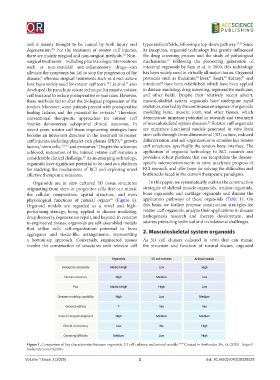
               Organoids are  in vitro cultured 3D tissue structures   In this paper, we systematically outline the construction
            originating from stem or progenitor cells that can mimic   strategies of skeletal muscle organoids, tendon organoids,
            the cellular composition, spatial structure, and even   bone organoids, and cartilage organoids and discuss the
                                                16
            physiological functions of natural organs  (Figure  1).   application pathways of these organoids (Table 1). On
            Organoid models are regarded as a novel and high-  this basis, we further propose construction strategies for
            performing strategy, being applied to disease modeling,   rotator cuff organoids, analyze their applications in disease
            drug discovery, regenerative repair, and beyond. In contrast   pathogenesis research and therapy development, and
            to engineered tissues, organoids are self-assembled models   address prevailing technical and translational challenges.
            that utilize cells’ self-organization potential to form   2. Musculoskeletal system organoids
            aggregates and tissue-like arrangements, representing
            a  bottom-up  approach.  Conversely,  engineered  tissues   As 3D cell clusters cultured  in  vitro that can mimic
            involve the construction of structures with relevant cell   the structure and function of natural tissues, organoid


            Figure 1. Comparison of key characteristics between organoids, 2D cell cultures, and animal models. 25-27  Created in BioRender. Shi, Q. (2025)  https://
            BioRender.com/7k2i76x.

            Volume 1 Issue 3 (2025)                         2                            doi: 10.36922/OR025320025

