


Page 153 - OR-1-3
P. 153
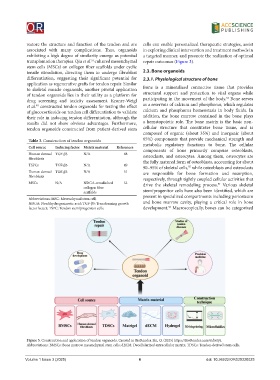
restore the structure and function of the tendon and are   cells can enable personalized therapeutic strategies, assist
            associated with many complications. Thus, organoids   in exploring clinical intervention and treatment methods in
            exhibiting a high degree of similarity emerge as potential   a targeted manner, and promote the realization of optimal
            transplantation therapies. Qiu et al.  cultured mesenchymal   repair outcomes (Figure 3).
                                        53
            stem cells (MSCs) on collagen fiber scaffolds under cyclic
            tensile stimulation, directing them to undergo fibroblast   2.3. Bone organoids
            differentiation,  suggesting  their  significant  potential  for   2.3.1. Physiological structure of bone
            application as regenerative grafts for tendon repair. Similar
            to skeletal muscle organoids, another pivotal application   Bone is a mineralized connective tissue that provides
            of tendon organoids lies in their utility as a platform for   structural  support  and  protection  to  vital  organs  while
                                                                                                 54
            drug screening and toxicity assessment. Kroner-Weigl   participating in the movement of the body.  Bone serves
            et al.  constructed tendon organoids for testing the effect   as a reservoir of calcium and phosphorus, which regulates
                48
            of glucocorticoids on tendon cell differentiation to validate   calcium and phosphorus homeostasis in body fluids. In
            their role in inducing tendon differentiation, although the   addition, the bone marrow contained in the bone plays
            results did not show obvious advantages. Furthermore,   a hematopoietic role. The bone matrix is the basic non-
            tendon organoids constructed from patient-derived stem   cellular structure that constitutes bone tissue, and is
                                                              composed  of  organic  (about  35%)  and  inorganic  (about

             Table 3. Construction of tendon organoids        65%) components that provide mechanical strength and
             Cell source  Inducing factor  Matrix material  References  metabolic regulatory functions to bone. The cellular
                                                              components of bone primarily comprise osteoblasts,
             Human dermal  TGF-β3    N/A              48      osteoclasts, and osteocytes. Among them, osteocytes are
             fibroblasts                                      the fully matured form of osteoblasts, accounting for about
             TSPCs       TGF-β3      N/A              49      90–95% of skeletal cells,  while osteoblasts and osteoclasts
                                                                                 55
             Human dermal  TGF-β3    N/A              51      are responsible for bone formation and resorption,
             fibroblasts                                      respectively, through tightly coupled cellular activities that
             MSCs        N/A         NDGA-crosslinked   53    drive the skeletal remodeling process.  Various skeletal
                                                                                              54
                                     collagen fiber
                                     scaffolds                stem/progenitor cells have also been identified, which are
             Abbreviations: MSC: Mesenchymal stem cell;       present in specialized compartments including periosteum
             NDGA: Nordihydroguaiaretic acid; TGF-β3: Transforming growth   and bone marrow cavity, playing a critical role in bone
                                                                         56
             factor beta 3; TSPC: Tendon stem/progenitor cells.  development.  Macroscopically, bones can be categorized


            Figure 3. Construction and application of tendon organoids. Created in BioRender. Shi, Q. (2025) https://BioRender.com/6id61yz.
            Abbreviations: BMSCs: Bone marrow mesenchymal stem cells; dECM: Decellularized extracellular matrix; TDSCs: Tendon-derived stem cells.


            Volume 1 Issue 3 (2025)                         6                            doi: 10.36922/OR025320025

