


Page 154 - OR-1-3
P. 154
into long bones, short bones, flat bones, and irregular   to the body’s bone tissue, bone organoids hold a promising
            bones, which are distributed in different anatomical regions   application prospect in the research of skeletal diseases.
            of the body and fulfill distinct functions. For example,   Xie  et al.   constructed  engineered  bone  healing  tissue
                                                                      58
            the short bones distributed in the hands and feet have an   organoids  using  BMSCs  and  hydrogel  microspheres  and
            irreplaceable role in the body’s ability to perform complex   used them to repair bone defects in rabbits, enabling rapid
                                                                                                  64
            and fine movements. 57                            bone regeneration within 4 weeks. Park et al.  established
                                                              trabecular bone organoids by co-culturing bone lining cells
            2.3.2. Construction of bone organoids             and bone marrow mononuclear cells on demineralized
            Compared  with  other  organoids of  the  musculoskeletal   bone matrix scaffolds, thus enabling investigation of the
            system, bone organoid fabrication has been well investigated,   process of local bone remodeling. Extending their utility
            and the construction strategies are relatively mature. The   beyond  restorative  therapies,  bone organoids  serve  as
            most common cell sources for bone organoid construction   versatile platforms for constructing pathomimetic disease
                                                                                       65
                           59
                     58
            are MSCs,  iPSCs,  as well as human periosteum-derived   models. Frenz-Wiessner  et al.  generated human bone
            cells and embryonic stem cells. iPSCs, which are somatic   marrow organoids using commercially available iPSCs and
            cells genetically reprogrammed to have the characteristics   leveraged them for genetic disease modeling. Iordachescu
                                                                 66
            of embryonic stem cells,  have been extensively applied in   et al.  engineered trabecular bone organoids by co-culturing
                                55
            organoid construction. iPSCs, used as the source for mouse   human osteoblasts and osteoclast precursors as well as
            organoids by O’Connor et al., through the time-dependent   bovine femoral trabecular fragments derived from New
                                   60
            sequential exposure of growth factors, successfully realized   Zealand cattle, and then, the organoids were subsequently
            the construction of osteochondral organoid. Cardier et al.    exposed to microgravity to simulate the process of bone
                                                          61
            Successfully generate osteogenic organoids using allogeneic   loss, providing a reliable model for osteoporosis research.
            MSCs with collagen microbeads and PRP clots as ECM   Furthermore, bone organoids have been utilized to model
            and scaffolds. These organoids were subsequently used for   pathological conditions of diseases including bone tumors,
            the treatment of congenital pseudoarthrosis of the tibia.   osteomyelitis, and bone deformities (Figure 4). 67
            Beyond that, Fuller et al.  established cost-effective bone   2.4. Cartilage organoids
                                 62
            organoid models by inoculating the mouse preosteoblast
            cell lines into hydrogel extracellular matrices, which can   2.4.1. Physiological structure of cartilage
            reduce  the  use  of  animal  models.  Matrix  materials,  as   Cartilage is a highly specialized, avascular, and aneural
            the integral components of bone organoid construction,   connective  tissue  that  provides  support,  protection,
            have also undergone significant advancements. Matrigels,   shock absorption, and friction reduction in the human
            natural biochemical hydrogels, and synthetic biochemical   body. It is primarily located in synovial joints, the spine,
            hydrogels have been increasingly employed and refined   ribs, trachea, and other regions.  Cartilage consists
                                                                                           68
            for the fabrication of bone organoids to increase the   mainly of chondrocytes and ECM, with the latter
            construction efficiency  and  to meet  specific  purposes   determining the distinct properties of different cartilage
            (Table 4). 63                                     types. Chondrocytes are responsible for synthesizing
                                                              and secreting ECM components, including collagen and
            2.3.3. Applications of bone organoids             proteoglycans, and also secrete cytokines to regulate tissue
            Bone  disease  is  a  relatively  common  non-fatal  disease,   repair and the cartilage microenvironment.  Within the
                                                                                                  69
            including fractures, osteoarthritis, osteoporosis, and bone   ECM components, collagen fibrils primarily provide tensile
            tumors, which can impair the motor function of patients,   strength and structural stability, whereas proteoglycans
            cause economic burden, and seriously affect their quality of   confer compressive resistance.  Based on compositional
                                                                                       68
            life. As an in vitro cell culture model that is highly similar   variations in the ECM, cartilage is classified into three
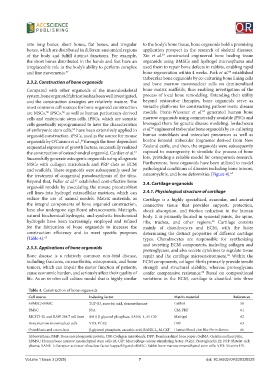
             Table 4. Construction of bone organoids
             Cell source               Inducing factor                     Matrix material          References
             hBMSC/rBMSC               TGF-β3, ascorbic acid, dexamethasone  GelMA                     58
             BMSC                      N/A                                 CM, PRP                     61
             MC3T3-E1 and RAW 264.7 cell lines  BMP, β-glycerol phosphate, RANK-L, M-CSF  Matrigel     62
             Bone marrow mononuclear cells  VD3, PGE2                      DBP                         63
             Osteoblasts and osteoclasts  β-glycerol phosphate, ascorbic acid, RANK-L, M-CSF  Human blood clot-like fibrin domes  66
             Abbreviations: BMP: Bone morphogenetic protein; CM: Collagen microbeads; DBP: Demineralized bone paper; GelMA: Gelatin methacrylate;
             hBMSC: Human bone marrow mesenchymal stem cells; M-CSF: Macrophage colony-stimulating factor; PGE2: Prostaglandin E2; PRP: Platelet-rich
             plasma; RANK-L: Receptor activator of nuclear factor-kappa B ligand; rBMSC: Rabbit bone marrow mesenchymal stem cells; VD3: Vitamin D3.


            Volume 1 Issue 3 (2025)                         7                            doi: 10.36922/OR025320025

