


Page 152 - OR-1-3
P. 152
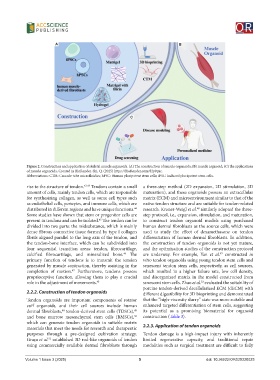
A                                                   B


                                                        C


            Figure 2. Construction and application of skeletal muscle organoids. (A) The construction of muscle organoids; (B) muscle organoid; (C) the applications
            of muscle organoids. Created in BioRender. Shi, Q. (2025) https://BioRender.com/82y9pxc.
            Abbreviations: CTM: Cascade tube microfluidics; hPSC: Human pluripotent stem cells; iPSC: Induced pluripotent stem cells.

            rise to the structure of tendon. 42,43  Tendons contain a small   a three-step method (2D expansion, 2D stimulation, 3D
            amount of cells, mainly tendon cells, which are responsible   maturation), and these organoids possess an extracellular
            for synthesizing collagen, as well as some cell types such   matrix (ECM) and microenvironment similar to that of the
            as endothelial cells, pericytes, and immune cells, which are   native tendon structure and are suitable for tendon-related
            distributed in different regions and have unique functions.    research. Kroner-Weigl et al.  similarly adopted the three-
                                                          44
                                                                                     48
            Some studies have shown that stem or progenitor cells are   step protocol, i.e., expansion, stimulation, and maturation,
            present in tendons and can be isolated.  The tendon can be   to construct tendon organoid models using purchased
                                           45
            divided into two parts: the midsubstance, which is mainly   human dermal fibroblasts as the source cells, which were
            dense fibrous connective tissue formed by type I collagen   used to study the effect of dexamethasone on tendon
            fibrils aligned parallel to the long axis of the tendon, and   differentiation of human dermal fibroblasts. In addition,
            the tendon-bone interface, which can be subdivided into   the construction of tendon organoids is not yet mature,
            four sequential transition areas: tendon, fibrocartilage,   and the optimization studies of the construction protocol
            calcified  fibrocartilage,  and  mineralized  bone.   The   are underway. For example, Yan  et al.  constructed  in
                                                                                               49
                                                      46
            primary function of tendons is to transmit the tension   vitro tendon organoids using young tendon stem cells and
            generated by muscle contraction, thereby assisting in the   senescent tendon stem cells, respectively, as cell sources,
            completion of motion.  Furthermore, tendons possess   which resulted in a higher failure rate, low cell density,
                                47
            proprioceptive function, allowing them to play a crucial   and disorganized matrix in the model constructed from
            role in the adjustment of movements. 43           senescent stem cells. Zhao et al.  evaluated the suitability of
                                                                                       52
                                                              porcine tendon-derived decellularized ECM (dECM) with
            2.2.2. Construction of tendon organoids           different digestibility for 3D bioprinting and demonstrated
            Tendon organoids are important components of rotator   that the “high-viscosity slurry” state was more suitable and
            cuff organoids, and their cell sources include human   enhanced targeted differentiation of stem cells, suggesting
            dermal fibroblasts,  tendon-derived stem cells (TDSCs),    its potential as a promising biomaterial for organoid
                                                          49
                           48
            and bone marrow mesenchymal stem cells (BMSCs),    construction (Table 3).
                                                          50
            which can generate tendon organoids in suitable matrix
            materials that meet the needs for research and therapeutic   2.2.3. Application of tendon organoids
            purposes through a pre-designed cultivation strategy.   Tendon damage is a high-impact injury with inherently
            Graça et al.  established 3D rod-like organoids of tendon   limited regenerative capacity, and traditional repair
                      51
            using commercially available dermal fibroblasts through   modalities such as surgical treatment are difficult to fully

            Volume 1 Issue 3 (2025)                         5                            doi: 10.36922/OR025320025

