


Page 41 - TD-3-3
P. 41
Tumor Discovery                                                    LncRNA HA117 in osteosarcoma regulation


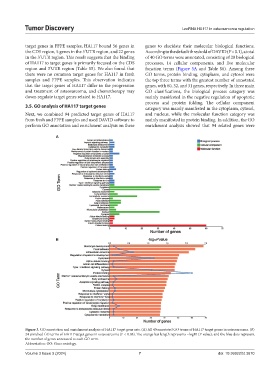
            target genes in FFPE samples, HA117 bound 56 genes in   genes  to elucidate their  molecular biological functions.
            the CDS region, 5 genes in the 5’UTR region, and 22 genes   According to the default threshold of DAVID (P < 0.1), a total
            in the 3’UTR region. This result suggests that the binding   of 40 GO terms were annotated, consisting of 20 biological
            of HA117 to target genes is primarily focused on the CDS   processes, 14  cellular components, and  five molecular
            region and 3’UTR region (Table S5). We also found that   function terms (Figure  3A and Table S6). Among these
            there were no common target genes for HA117 in fresh   GO terms, protein binding, cytoplasm, and cytosol were
            samples and FFPE samples. This observation indicates   the top three terms with the greatest number of annotated
            that the target genes of HA117 differ in the progression   genes, with 60, 32, and 31 genes, respectively. In three main
            and treatment of osteosarcoma, and chemotherapy may   GO classifications, the biological process category was
            down-regulate target genes related to HA117.       mainly manifested in the negative regulation of apoptotic
                                                               process and protein folding. The cellular component
            3.5. GO analysis of HA117 target genes             category was mainly manifested in the cytoplasm, cytosol,

            Next, we combined 94 predicted target genes of HA117   and nucleus, while the molecular function category was
            from fresh and FFPE samples and used DAVID software to   mainly manifested in protein binding. In addition, the GO
            perform GO annotation and enrichment analysis on these   enrichment analysis showed that 94 related genes  were


                         A


                         B


            Figure 3. GO annotation and enrichment analysis of HA117 target gene sets. (A) All 40 annotated GO terms of HA117 target genes in osteosarcoma. (B)
            24 enriched GO terms of HA117 target genes in osteosarcoma (P < 0.05). The orange bar length represents −log10 (P-value), and the blue dots represent
            the number of genes annotated to each GO term.
            Abbreviation: GO: Gene ontology.
            Volume 3 Issue 3 (2024)                         7                                 doi: 10.36922/td.3670

